ADA Wheelchair Ramp Requirements: 2026 Guide + Length Calculator
Every ADA rule for wheelchair ramps — slope, landings, handrails, width, and surface — plus an interactive calculator that tells you the exact length you need.

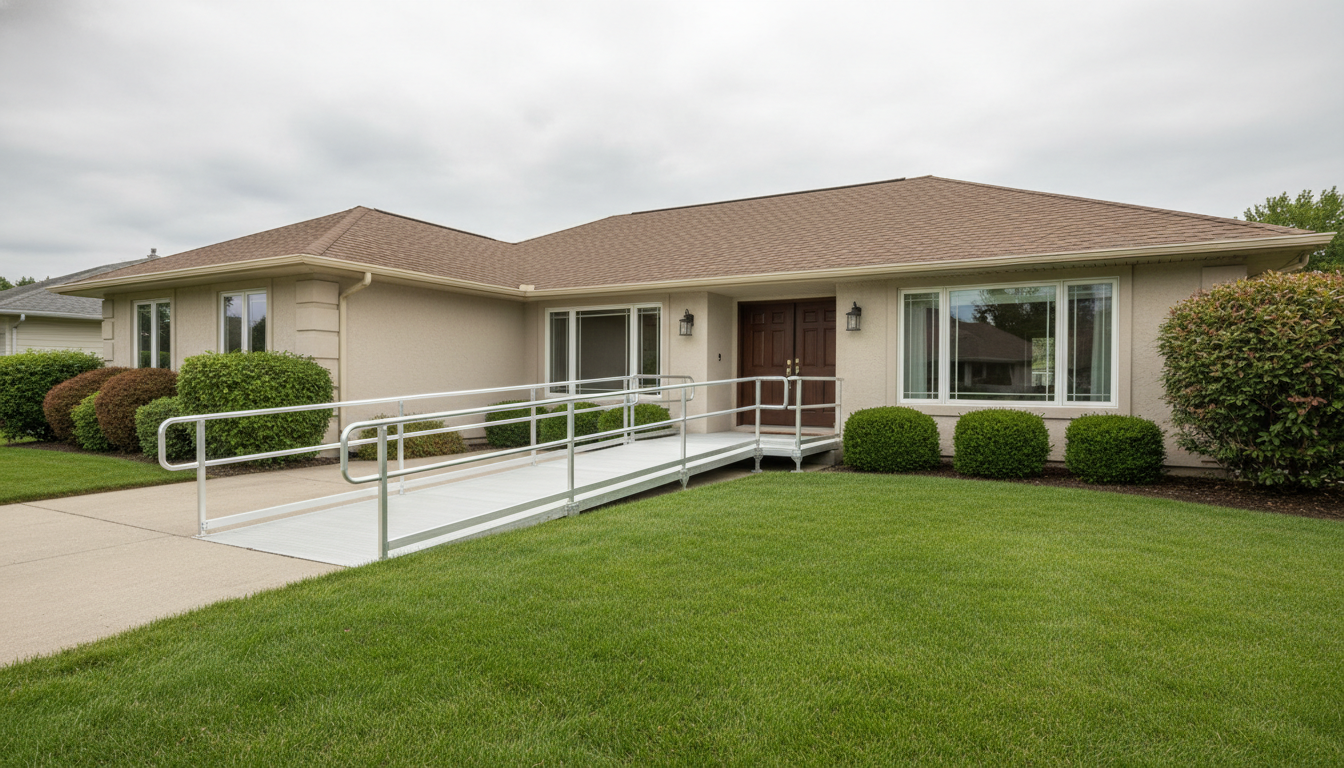
Wheelchair ramps look simple, but building one that’s actually safe, legal, and usable follows a specific rulebook — the 2010 ADA Standards for Accessible Design. This guide covers every ADA requirement that applies to residential and commercial wheelchair ramps in 2026, with a calculator that tells you exactly how long your ramp needs to be based on your rise.
The 1:12 Slope Rule: The Foundation of ADA Design
Every ADA requirement for wheelchair ramps starts with one ratio: for every 1 inch of vertical rise, the ramp must extend at least 12 inches horizontally. This 1:12 slope (equivalent to a 4.8° angle or 8.33% grade) is the maximum allowed for any new ADA-compliant ramp. Steeper is unsafe; less steep is better.
Why 1:12? Independent wheelchair users can propel themselves up a 1:12 grade using arm strength alone, maintain control on the descent without rolling too fast, and operate in wet weather without losing traction. Anything steeper forces users to ask for help or risk injury.
The practical result: a 24-inch porch rise requires a 24-foot ramp run. A 36-inch rise requires 36 feet. This is why most home front entrances end up needing a switchback layout — few residential lots have 30–40 feet of straight space.
Wheelchair Ramp Length Calculator
Enter your vertical rise to see the minimum ADA-compliant ramp length, required landings, and handrail requirements:
Estimate for ADA 1:12 slope. Landings assume 5-ft length each. Switchback layouts may require additional landings. For final plans, consult a licensed contractor or our ramp consultation team.
Landing Requirements at Top, Bottom, and Turns
Landings are the flat platforms at the end of every ramp run. ADA requires landings in three specific places:
- Top of every ramp — at least 60 inches (5 feet) long and at least as wide as the ramp itself. Must be level in all directions.
- Bottom of every ramp — same dimensions as the top landing, providing a clear, flat area for boarding and dismounting.
- At every turn or direction change — a 60-inch-by-60-inch landing is required wherever the ramp changes direction, including switchback reversals.
For residential door approaches, the top landing typically needs to be at least 18 inches past the door’s latch side to give wheelchair users space to reach the handle. Failing to account for this door-swing clearance is the #1 mistake DIY builders make.
Maximum Continuous Run Between Landings
ADA limits any unbroken ramp run to 30 feet (30 inches of rise) between landings. Longer runs must include intermediate landings every 30 feet to give users a place to rest.
- Rise up to 30 in → 1 continuous run possible (30-ft ramp + 2 landings)
- Rise 31–60 in → 2 runs separated by 1 intermediate landing
- Rise 61–90 in → 3 runs separated by 2 intermediate landings
Most residential porches sit 18–30 inches above ground level, so a single straight run is usually enough — assuming you have the linear space. When you don’t, a switchback layout folds the ramp back on itself with a landing at the turn.
Handrail Requirements: Heights and Extensions
Handrails are required on both sides of any ramp with a vertical rise greater than 6 inches or a horizontal run greater than 72 inches. The specifications:
- Height: 34–38 inches above the ramp surface, measured vertically from the top of the handrail gripping surface
- Extensions: Must extend at least 12 inches horizontally beyond the top and bottom of each ramp run (so users can grasp the rail before stepping onto or off of the slope)
- Graspable diameter: Circular cross-section 1.25–2 inches in diameter, or equivalent gripping surface for non-round designs
- Clearance from wall: 1.5 inches minimum between the handrail and any adjacent wall or structure
- Continuity: Handrails should be continuous along the full length of the ramp and around landings where possible
- Structural capacity: Must support a 250 lb point load applied in any direction
For residential ramps under 6 inches of rise (e.g., a single-step entry), handrails are optional but often recommended for seniors using walkers or canes.
Ramp Width and Edge Protection
ADA specifies a minimum ramp width of 36 inches measured between the handrails. For two-way traffic or wider wheelchairs (e.g., bariatric chairs), a 48-inch width is recommended.
Edge protection prevents wheelchair casters from rolling off the side of the ramp. ADA requires one of these three treatments along any ramp edge without a wall:
- A 4-inch curb running the full length of the ramp
- A railing or barrier positioned so that a 4-inch sphere cannot pass between the ramp surface and the barrier
- A projecting wall or vertical surface at the ramp edge
Most modular aluminum ramp systems include 2–3 inch integrated curbs by default, which meet or exceed the ADA spec.
Surface and Traction Requirements
The ramp surface must be stable, firm, and slip-resistant in all weather conditions. Acceptable surfaces include:
- Slip-resistant aluminum with raised tread pattern (most common for modular ramps)
- Poured concrete with broom-finish texture
- Treated wood with anti-slip strips or textured paint
- Composite decking rated for slip resistance (coefficient of friction 0.6 or higher)
Smooth concrete, glossy-finished wood, or metal plate without traction treatment does not meet ADA — these surfaces become dangerously slick when wet or icy.
Residential vs. Commercial ADA Requirements
ADA’s ramp standards technically only apply to public accommodations and commercial facilities — private single-family residences are exempt from federal ADA enforcement. However, three factors mean most residential ramp projects still follow ADA specs:
- State and local codes often adopt ADA standards as the baseline for all construction, including residential ramps requiring permits.
- Grant programs and funding sources require ADA compliance — Medicaid HCBS waivers, VA HISA grants, and USDA 504 loans all specify ADA-compliant construction as a funding condition.
- Liability and resale value improve with ADA compliance — a non-compliant ramp can be a disclosure issue at resale and a liability risk if a visitor is injured.
See our ramps and accessibility resource page for a complete breakdown of portable, modular, and permanent ramp options that meet ADA specifications out of the box.
Common ADA Mistakes and How to Avoid Them
Five mistakes that turn up on residential ramp inspections:
- Slope too steep — Contractors sometimes propose 1:10 or 1:8 to “save space.” These are acceptable only for existing/altered construction when true ADA compliance is impossible — and even then, 1:10 requires max 6-inch rise and 1:8 max 3-inch rise.
- Skipping the top landing — Leading the ramp directly to the door without a 60x60-inch flat area is the most common failure. It makes opening the door while seated in a wheelchair nearly impossible.
- Inadequate handrail extensions — Handrails that stop at the ramp edge (not 12 inches past) fail inspection and feel unsafe to users.
- Wrong handrail height — DIY builders often install rails at 36 inches exactly (standard porch railing height) without verifying the top of the grip surface falls within 34–38 inches above the ramp.
- No edge protection — Open-sided ramps without curbs or barriers fail ADA even when everything else is correct.
When to Hire a Pro vs. Build It Yourself
A modular aluminum ramp system is designed for DIY assembly and can be installed by a handy homeowner in one day. These systems come with pre-engineered components, ADA-compliant slope, and integrated handrails — you’re essentially bolting together Lego pieces.
Wood or concrete construction is a different matter. Slope calculations, landing framing, handrail structural integrity, and permit drawings all benefit from a licensed contractor experienced with accessibility work. Typical professional construction cost: $2,000–$8,000 depending on length and material.
For short ramps under 6 feet (serving a 6-inch threshold or single step), portable folding ramps in the $100–$500 range are usually the best answer. No construction, no permit, no installation — just unfold and use.
The Bottom Line on ADA Wheelchair Ramp Requirements
Every ADA-compliant wheelchair ramp follows six rules: 1:12 maximum slope, 60-inch landings at both ends and at every turn, 30-foot maximum continuous run, handrails on both sides above 6-inch rise, 36-inch minimum width, and slip-resistant surface with edge protection. Most residential projects meet these specs out-of-the-box with modular aluminum systems; custom wood or concrete work benefits from professional design.
Need help designing or selecting a ramp for your specific home layout? Contact our team for a free 15-minute consultation. We’ll help you calculate the exact length needed, recommend ADA-compliant systems, and connect you with certified installers in your area. For funding options that cover ramp costs, read our guide on free wheelchair ramp programs.