Straight Stair Lift Guide: 5 Best Models, Cost & Install for 2026
Bruno, Acorn, AmeriGlide, Stannah, Harmar — the 5 straight stair lift models worth comparing, with all-in 2026 pricing from $2,500 to $5,000.

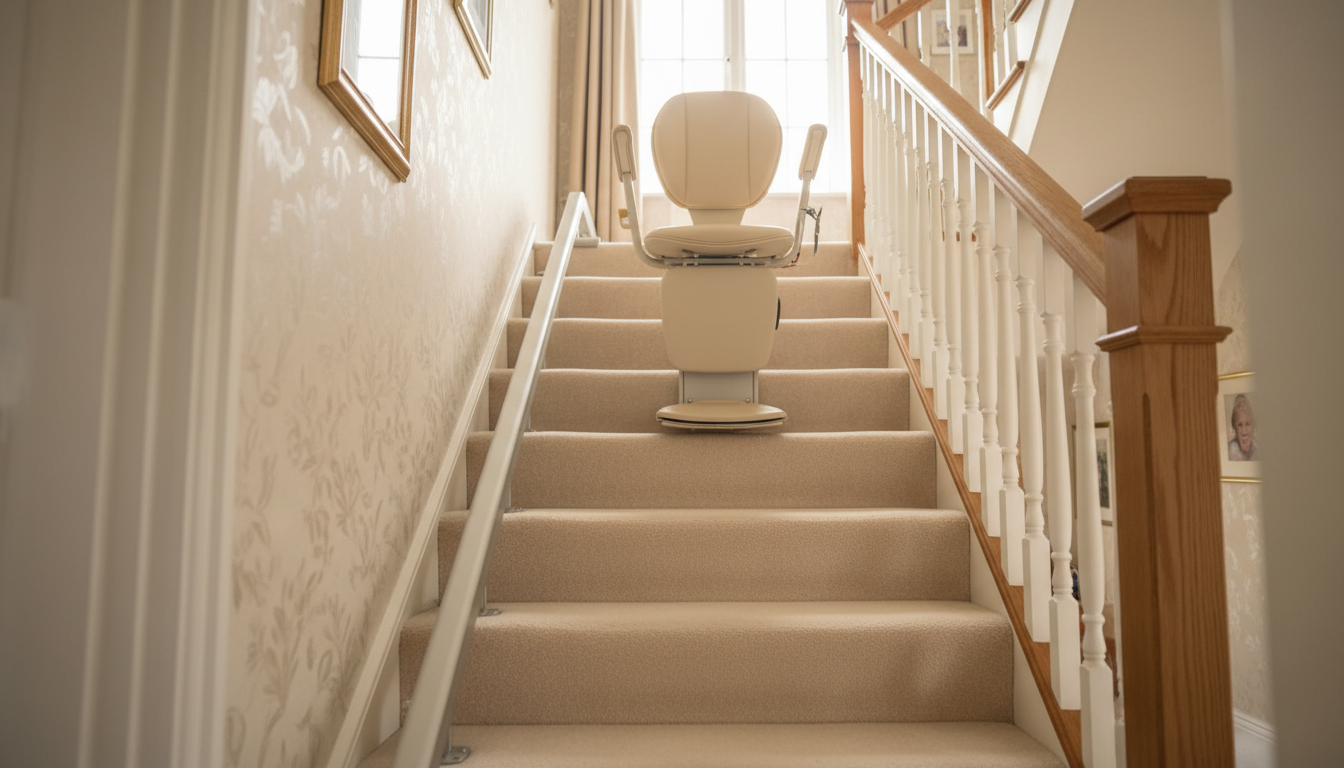
A straight stair lift fits any staircase that runs in a single unbroken line from one floor to the next — no turns, no landings, no intermediate platforms. For 70% of American homes with standard single-flight stairs, the straight stair lift is the right answer: faster to install, cheaper to buy, and simpler to maintain than a curved model. This guide compares the top 2026 models, walks through the decision between them, and flags the features that actually matter.
What a Straight Stair Lift Actually Is
A straight stair lift consists of four parts: a pre-fabricated aluminum rail cut to the length of your staircase, a motorized carriage that travels along the rail, a padded seat with armrests and a footrest, and a rechargeable battery pack that powers the carriage. The rail mounts to the stair treads — not to the wall — so no structural modifications are required.
The user sits, presses a paddle or toggle on the armrest, and the carriage moves smoothly from one end of the stairs to the other. A safety belt restrains the user during the ride, safety sensors halt the lift if anything obstructs the rail, and the seat swivels at the top and bottom landings to make stepping off safe and easy.
Straight lifts are universally easier to install than curved lifts because the rail is standard. An installer measures your staircase, cuts the rail to length on-site, and anchors it with heavy-duty brackets. A typical install takes 2–4 hours. See our stair lift installation walkthrough for what install day looks like in practice.
Straight Stair Lift Cost in 2026
All-in pricing for a straight stair lift in 2026, including hardware, rail, install labor, and typical accessories:
| Configuration | Hardware | Install Labor | All-in Total |
|---|---|---|---|
| Indoor straight (standard) | $2,200–$4,200 | $300–$600 | $2,500–$5,000 |
| Indoor straight with power swivel | $2,800–$4,800 | $350–$650 | $3,100–$5,500 |
| Outdoor straight (weather-sealed) | $3,500–$6,500 | $500–$900 | $4,000–$7,500 |
| Heavy-duty (400+ lb capacity) | $3,200–$5,500 | $400–$700 | $3,600–$6,200 |
| Used straight (2–5 years old) | $800–$2,000 | $400–$700 | $1,200–$2,700 |
Want the full line-item breakdown? See our stair lift installation cost guide for what labor, electrical, and permits actually cost.
Top Straight Stair Lift Models for 2026
Five models dominate the straight stair lift market. Each has a specific strength:
| Model | All-in Price | Weight Capacity | Warranty | Strength |
|---|---|---|---|---|
| Bruno Elan SRE-3050 | $3,800–$5,000 | 300 lb | Lifetime on major components | Made in USA, premium build quality |
| Acorn 130 | $2,500–$3,800 | 309 lb | 5 years on motor, 2 years on parts | Fastest install, strong used market |
| AmeriGlide Rave | $2,400–$3,500 | 300 lb | Lifetime on major components | DIY-friendly, best budget option |
| Stannah Siena 600 | $3,500–$4,800 | 352 lb | 2 years full, 5 years motor | Quietest operation, best for open floorplans |
| Harmar Pinnacle SL600 | $3,000–$4,300 | 350 lb | Lifetime major, 3 years parts | Heavy-duty capacity for larger users |
Bruno Elan SRE-3050 — Premium Choice
The Bruno Elan is the stair lift most likely to outlast its owner. Made in Wisconsin with a lifetime warranty on the motor, rail, and gearbox, it’s the model that stair lift installers buy for their own parents. The seat folds flat against the wall when not in use, which matters in narrower staircases. Expect $3,800–$5,000 all-in.
Acorn 130 — Fastest Delivery
Acorn’s dealer network will often install within 3–5 business days of the site survey, making it the go-to when a senior is discharged from rehab and needs stair access immediately. The 5-year motor warranty is shorter than Bruno’s but still solid. Pricing runs $2,500–$3,800 all-in.
AmeriGlide Rave — Best Budget
AmeriGlide sells direct-to-consumer and supports DIY installation for handy homeowners, which can shave $400–$600 off the total. The Rave uses a Swedish-made drive system rebadged under the AmeriGlide brand. Lifetime warranty on the major components makes it the strongest value at under $3,500 installed.
Stannah Siena 600 — Quietest
Stannah lifts run 40–45 decibels — noticeably quieter than competitors’ 50–55 dB operation. Worth paying extra for if the staircase is near bedrooms or if the user is sensitive to mechanical noise. The Siena also has the widest standard seat (17.5 inches).
Harmar Pinnacle SL600 — Heavy-Duty
The SL600 supports up to 350 lb and features a reinforced rail, wider seat, and upgraded motor. If the primary user is over 280 lb or if multiple family members will use the lift, Harmar’s heavy-duty frame justifies the extra $500–$800 over a standard model.
Straight vs. Curved: Which Do You Need?
The decision is almost always determined by your staircase, not your preferences:
- Single straight flight of stairs, no turns: Straight stair lift. Always.
- L-shaped, U-shaped, or staircase with landing: Curved stair lift required, OR install two straight lifts (one per flight) if landing is large enough.
- Spiral staircase: Curved stair lift — often with significant custom engineering.
When you have a staircase with a single landing, the two-straight-lift workaround saves $6,000–$12,000 versus a curved lift, because pre-fabricated straight rails cost far less than custom curved rails. The trade-off: the user must transfer between lifts at the landing, which some users find acceptable and others find exhausting.
Features That Actually Matter
Not every feature in a stair lift brochure affects daily use. Here are the four that make a real difference:
- Power swivel seat ($400–$800 upgrade) — Critical for users with shoulder or hip weakness. The seat motor rotates toward the landing automatically; manual swivel requires physical exertion that defeats the purpose of the lift.
- Folding rail ($300–$700 upgrade) — Necessary if the bottom of your stairs opens into a hallway, door swing zone, or narrow walkway. The rail folds up when not in use to keep the path clear.
- Dual remote controls ($50–$200 upgrade) — Lets a caregiver call the lift from either end. Nearly every modern lift includes two remotes standard; verify if buying used.
- Battery backup (standard on most models) — Every modern straight lift includes a rechargeable battery that runs the lift during power outages for 10–20 trips. See our stair lift battery backup guide for details.
Straight Stair Lift Warranty Comparison
Warranty is where manufacturers compete hardest on straight lifts because the hardware is so similar. Coverage you should look for:
- Motor/gearbox warranty: 5 years minimum, lifetime preferred
- Rail warranty: Lifetime from Bruno, AmeriGlide, and Harmar; 10 years from most competitors
- Electronics warranty: 2–3 years typical; Stannah offers the only 5-year electronics warranty at retail
- Wearable parts (belts, battery packs, upholstery): 1–2 years standard — check exclusions before buying
- Labor coverage: Some warranties cover parts only, not the labor to install replacement parts. Factory-authorized dealers usually bundle labor.
Read our stair lift warranty comparison for detailed side-by-side coverage breakdowns across all major brands.
Installation Timeline for a Straight Stair Lift
From the day you order to the day the lift is operational:
- Site survey (Day 0) — Installer measures staircase, confirms outlet location, takes photos. 30–45 minutes.
- Order and fabrication (Days 1–5) — Rail is cut to length at the factory or warehouse. Most straight lifts ship in 3–5 business days; Acorn and AmeriGlide sometimes same-week.
- Installation (Day 5–10) — Rail mounting, carriage assembly, seat install, electrical connection, testing, user training. 2–4 hours on-site.
- First-month checkup (optional) — Bruno and Stannah dealers often do a free 30-day check. Worth accepting even if the lift runs perfectly.
Maintenance and Long-Term Ownership
Straight stair lifts are among the most reliable mechanical systems in a home — typical lifespan is 10–15 years with minimal maintenance:
- Annual service call ($150–$250) to clean rail, lubricate gearbox, test safety sensors, check battery health
- Battery replacement every 3–5 years ($50–$150 parts, $75–$150 labor if technician does it)
- Upholstery replacement at year 7–10 (optional, $150–$400)
- Motor rebuild rarely needed before year 12 on Bruno/Stannah; year 8 on budget models
See our most reliable stair lift models guide for long-term reliability data across all major brands.
The Bottom Line on Straight Stair Lifts
For a single-flight staircase, a straight stair lift costs $2,500–$5,000 all-in, installs in 2–4 hours, and lasts 10–15 years. Bruno Elan is the premium pick, Acorn 130 the fastest, AmeriGlide Rave the best budget, Stannah Siena the quietest, and Harmar Pinnacle the heavy-duty option. Power swivel seat is the single feature most worth upgrading; skip the decorative options.
Ready to compare quotes from local dealers or figure out whether a straight lift is right for your staircase? Contact our team for a free 15-minute consultation. We’ll help you interpret dealer quotes, compare models against your specific needs, and connect you with vetted installers in your area.