How to Avoid Nursing Home in 2026: 12 Proven Strategies to Age Safely at Home
A practical guide to keeping yourself or your elderly parent out of a nursing home — covering home modifications, professional care services, assistive technology, financial resources, and the step-by-step planning that makes aging in place a realistic alternative.


Why So Many Seniors Want to Avoid Nursing Homes
The desire to avoid a nursing home is one of the most common concerns expressed by older adults and their families. AARP research consistently shows that 77% of adults over 50 want to remain in their own homes as they age, and that number rises to nearly 90% among adults over 65. The reasons are deeply personal: familiarity, independence, dignity, connection to community, and the comfort of a space that holds a lifetime of memories.
Nursing homes serve an essential purpose for individuals who need 24-hour skilled nursing care. But many seniors end up in nursing facilities not because they truly require that level of care, but because their families did not know about the alternatives or did not plan soon enough. A 2024 study published in the Journal of the American Geriatrics Society found that up to 40% of nursing home residents could have remained at home with appropriate support services and home modifications.
The good news is that aging in place is more achievable in 2026 than ever before. Advances in home health care services, assistive technology, smart home monitoring, and home modification design have created a robust toolkit for keeping seniors safe and independent at home. The key is starting early, planning strategically, and building a comprehensive support system before a health crisis forces a reactive decision.
"The families who successfully avoid nursing home placement are almost always the ones who planned proactively — not the ones who scrambled after a hospital discharge."
Strategy 1: Make Your Home Physically Safe
The number one reason seniors transition to nursing homes prematurely is a fall that results in a serious injury — typically a hip fracture. Falls are not inevitable. They are preventable with the right home modifications, and making the home safe is the single most impactful step you can take to avoid nursing home placement.
Start with the bathroom. Over 80% of senior falls at home occur in the bathroom. Install grab bars beside the toilet and in the shower, replace slippery flooring with non-slip surfaces, convert the bathtub to a walk-in shower or add tub safety modifications, and install a comfort-height toilet. Our bathroom for senior citizens guide covers the complete scope of bathroom safety upgrades.
Address stairs and multi-level living. If the home has stairs, install a stairlift or consider converting a main-floor room into a bedroom to eliminate stair use. Add handrails on both sides of every stairway, ensure adequate lighting on each step, and apply non-slip treads to all stair surfaces.
Improve lighting throughout the home. Aging eyes require two to three times more light than younger eyes. Replace dim bulbs with bright LEDs (at least 800 lumens per fixture), install motion-activated night lights in hallways and bathrooms, and add task lighting in the kitchen and at reading areas. Automatic lights that turn on when someone enters a room eliminate the need to navigate dark spaces.
Remove tripping hazards. Eliminate throw rugs or secure them with double-sided carpet tape, route electrical cords along walls (never across walkways), clear clutter from pathways, and ensure all walkways are at least 36 inches wide for walker or wheelchair passage. Our home safety assessment guide provides a comprehensive room-by-room checklist. Also see our dedicated fall prevention resource.
Strategy 2: Bring Professional Care Into the Home
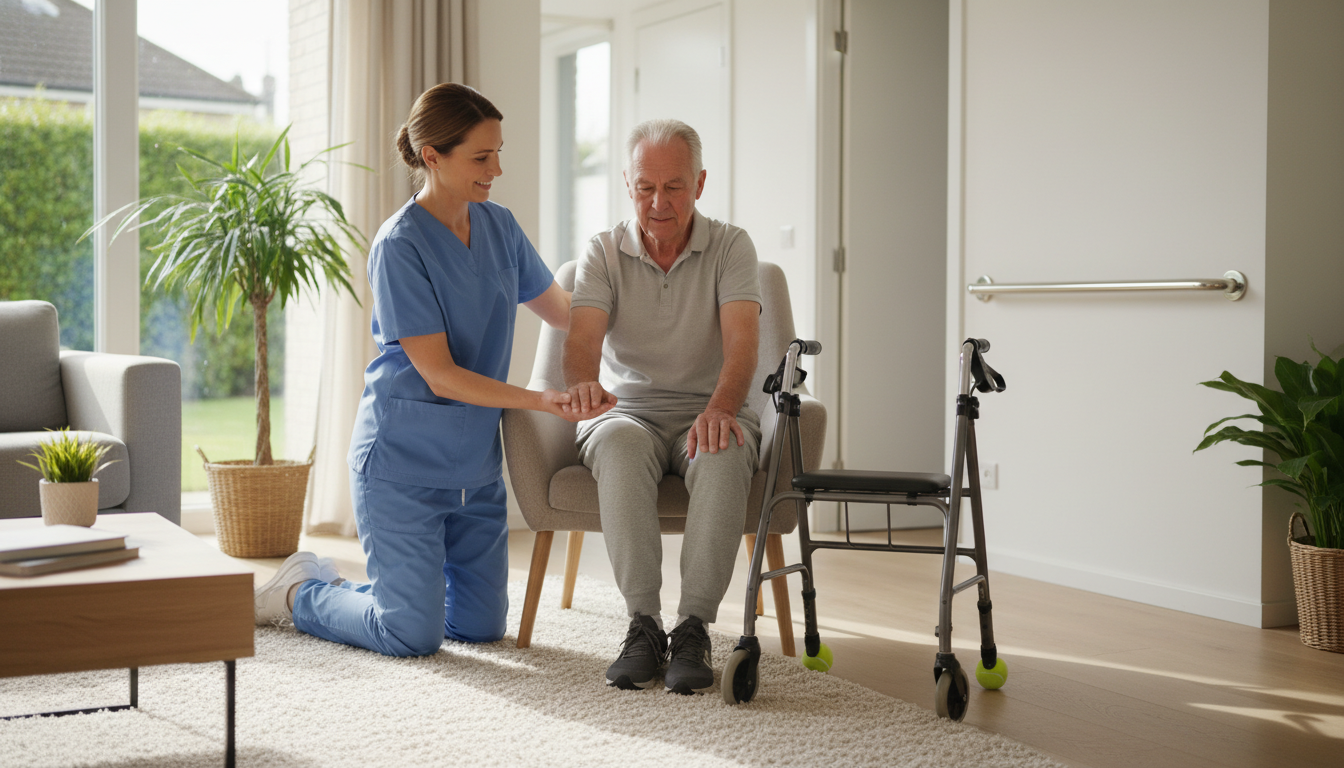
Professional home care services can replicate many of the services provided in a nursing home — but delivered in the comfort of the senior's own home. Understanding the different types of home care helps families assemble the right combination of support.
Home health aides (HHAs) assist with activities of daily living (ADLs): bathing, dressing, grooming, toileting, transferring, and meal preparation. They provide the personal care support that many seniors need to live independently. Costs average $28 to $33 per hour nationally. Most families start with 10 to 20 hours per week and increase as needs grow.
Skilled home health care involves licensed medical professionals — registered nurses, physical therapists, occupational therapists, and speech-language pathologists — who provide medical care in the home. This includes wound care, medication management, injection administration, rehabilitation therapy, and chronic disease monitoring. Medicare covers skilled home health care when prescribed by a physician and the patient is homebound.
Companion care focuses on social engagement and light household support rather than personal care. Companion caregivers provide conversation, accompany seniors on outings, help with light housekeeping, run errands, and provide transportation. This service addresses the social isolation that often accelerates cognitive and emotional decline, which in turn can lead to nursing home placement.
24-hour home care is possible through live-in caregivers (one caregiver who lives in the home and provides care during waking hours) or round-the-clock shifts (two or three caregivers rotating 8 to 12-hour shifts). Live-in care costs approximately $200 to $350 per day, while shift-based 24-hour care costs $450 to $700 per day. While expensive, 24-hour home care still costs less than a private nursing home room in many markets ($10,000 to $15,000 per month). Our independent assisted living guide covers all care service options in detail.
Strategy 3: Use Assistive Technology as a Force Multiplier
Technology cannot replace human caregivers, but it can dramatically extend the hours during which a senior can safely be alone — reducing the total care hours needed and making the economics of home-based care work better.
Medical alert systems are the most critical piece of technology for any senior living independently. These wearable devices allow one-button access to emergency help 24/7. Modern systems like Medical Guardian, Life Alert, and Bay Alarm Medical include automatic fall detection (the device calls for help even if the senior cannot press the button), GPS tracking for outdoor use, and two-way voice communication. Monthly costs range from $20 to $50. A medical alert system is non-negotiable for any senior living alone or spending significant hours without a caregiver. Visit our smart home monitoring resource for comprehensive technology options.
Smart home automation provides environmental safety without constant human oversight. Motion sensors can alert family members if the senior has not moved through the house by a certain time (indicating a potential fall or medical event). Smart stove monitors turn off the burner automatically if left unattended. Smart door locks allow family members to grant access to caregivers remotely. Voice assistants set medication reminders, make phone calls, and control lighting — all hands-free.
Medication management devices prevent the dangerous medication errors that frequently trigger hospital admissions and subsequent nursing home placement. Automatic pill dispensers like MedMinder and Hero dispense the correct medications at the right times and alert caregivers if a dose is missed. These devices cost $30 to $100 per month and can prevent the cascade of events that starts with a missed blood pressure pill and ends with a stroke and nursing home admission.
Remote health monitoring allows medical conditions to be tracked continuously without office visits. Bluetooth-connected blood pressure cuffs, glucose monitors, pulse oximeters, and scales transmit data to health care providers who can intervene early when readings trend in the wrong direction. Many Medicare Advantage plans now cover remote patient monitoring devices and services.
Strategy 4: Address Condition-Specific Care Needs at Home
Certain medical conditions are the most common triggers for nursing home admission. Having a condition-specific plan for managing these at home can prevent the crisis that leads to institutional placement.
Dementia and Alzheimer's care at home is possible through the mild to moderate stages with the right environment and support. Key strategies include securing the home against wandering (door alarms, GPS tracking devices, secure fencing), simplifying the environment (reducing clutter, labeling cabinets, using contrasting colors for hazards), establishing consistent daily routines, and arranging increasing levels of supervision as the disease progresses. Adult day programs specifically for individuals with dementia provide structured activities and socialization during the day while giving family caregivers essential respite.
Post-stroke recovery at home requires a coordinated approach. Medicare-covered home health care provides physical therapy, occupational therapy, and speech therapy in the home. Home modifications typically needed after a stroke include a hospital bed (covered by Medicare), a wheelchair ramp, a walk-in shower with bench seat, and grab bars throughout the home. Most stroke survivors can return home from rehabilitation if the home is properly modified and therapy services are in place. Our home medical equipment guide covers the devices that support post-stroke recovery.
Parkinson's disease management at home focuses on fall prevention and maintaining mobility. Physical therapy to maintain balance and strength, properly fitted mobility aids (walkers with handbrakes, weighted utensils for tremors), voice-activated smart home controls for tremor-affected hands, and bathroom safety modifications are all essential. The Michael J. Fox Foundation provides excellent resources for adapting the home environment for Parkinson's.
Chronic conditions like heart failure, COPD, and diabetes can be managed at home with remote monitoring, regular skilled nursing visits, medication management, and family education. The key is establishing a rapid-response plan: knowing exactly what symptoms require immediate medical attention, having a direct line to the supervising physician, and having an emergency plan that routes to the hospital rather than defaulting to nursing home placement after a health event.
Strategy 5: Understand and Access Financial Resources
The belief that nursing home care is the only affordable option for seniors with limited resources is one of the most damaging myths in elder care. Multiple financial assistance programs specifically support aging in place, and understanding them can make the difference between staying home and institutionalization.
| Funding Source | What It Covers | Eligibility |
|---|---|---|
| Medicare Home Health | Skilled nursing, therapy, medical social work | Homebound + physician order |
| Medicare Part B DME | Walkers, wheelchairs, hospital beds, oxygen | Physician prescription + medical necessity |
| Medicaid HCBS Waivers | Personal care aides, home mods, adult day, medical alerts | Income/asset limits (varies by state) |
| VA Aid & Attendance | Up to $2,431/month for care expenses | Wartime veteran + need for ADL assistance |
| VA HISA Grant | Home modifications up to $6,800 | Veteran with service-connected disability |
| Long-Term Care Insurance | Home care, adult day, home mods (varies) | Policy benefit triggers (usually 2+ ADL needs) |
| USDA Section 504 | Home repair grants up to $10,000 | Very-low-income rural homeowner 62+ |
Medicaid Home and Community-Based Services (HCBS) waivers are particularly important because they are specifically designed to keep people out of nursing homes. These programs provide personal care aides, home modifications, medical alert systems, adult day programs, meal delivery, and transportation services — all funded by Medicaid. The critical detail: Medicaid will pay for nursing home care automatically, but HCBS waiver slots often have waiting lists. Apply early, even if services are not needed immediately. Contact your state Medicaid office or Eldercare Locator to start the application process. For a complete financial planning guide, see our aging in place services guide.
Strategy 6: Build a Reliable Care Team
No one can keep a senior safely at home alone. The families who successfully avoid nursing home placement build a team that shares the care responsibilities and provides mutual support. Here is how to assemble that team.
Family caregivers are the backbone of most aging-in-place plans, but they must be supported to avoid burnout. The National Alliance for Caregiving reports that 36% of family caregivers describe their situation as highly stressful, and caregiver burnout is a leading trigger for nursing home placement. Divide responsibilities clearly: one person manages finances, another coordinates medical appointments, another handles home maintenance. Do not let one person carry everything.
A geriatric care manager (aging life care professional) serves as the quarterback of the care team. They assess the senior's needs, coordinate services across providers, mediate family disagreements about care decisions, navigate insurance and benefits applications, and provide crisis management when unexpected health events occur. Costs range from $100 to $250 per hour, and even a few hours of their expertise can prevent costly mistakes or missed resources.
A primary care physician who makes house calls can be transformative. Many seniors stop attending medical appointments because transportation is difficult or the physical demands of the doctor's office are too great. Missed medical care leads to unmanaged conditions, which lead to hospitalizations, which lead to nursing home placement. House call medicine is growing rapidly in 2026, with services like Heal, DispatchHealth, and independent house call physicians available in most metro areas. Medicare covers physician house calls.
Neighbors and community provide an informal safety net. Let trusted neighbors know the senior lives alone or with limited help. Exchange phone numbers. Ask them to watch for unusual patterns (newspapers piling up, lights not turning on, mail uncollected). Many communities have volunteer programs that provide friendly visits, meal delivery, yard work, and transportation for homebound seniors.
Strategy 7: Know All the Alternatives to Nursing Homes
If staying in the current home becomes impractical, several residential alternatives provide more support than independent living while maintaining more autonomy than a nursing home.
Assisted living facilities provide housing, meals, personal care assistance, medication management, and social activities in a residential community setting. They are appropriate for seniors who need help with ADLs but do not require 24-hour skilled nursing care. Average cost: $5,350 per month nationally. However, for some families the issue is not the level of care but the loss of home — and for those families, bringing services into the home often makes more sense.
Board and care homes (also called residential care homes or personal care homes) are private residences that provide room, board, and personal care for a small number of residents — typically 4 to 10. They offer a home-like environment with more individualized attention than larger facilities. Costs range from $1,500 to $5,000 per month and can be a good middle ground between home care and institutional care.
Adult day programs provide daytime supervision, activities, meals, and sometimes medical care while the senior returns home each evening. They are especially valuable for working family caregivers who need daytime coverage. Costs average $75 to $150 per day. Many Medicaid HCBS waiver programs cover adult day services.
Continuing Care Retirement Communities (CCRCs) offer a continuum from independent living through assisted living to skilled nursing on a single campus. The senior moves between levels of care as needs change. CCRCs require a significant entrance fee ($100,000 to $500,000+) plus monthly fees ($3,000 to $7,000), but they eliminate the uncertainty of where the senior will receive care if needs escalate. Our guide on when assisted living is not enough explores higher-level care transitions in detail.
Cost Comparison: Home Care vs. Nursing Home
One of the most persuasive arguments for avoiding a nursing home is financial. In many scenarios, a comprehensive home care plan costs significantly less than nursing home placement — especially when the senior owns their home outright.
| Care Scenario | Monthly Cost | Annual Cost |
|---|---|---|
| Nursing Home (semi-private room) | $8,669 | $104,025 |
| Nursing Home (private room) | $10,025 | $120,300 |
| Home Care: 20 hrs/week aide + medical alert | $2,500–$3,000 | $30,000–$36,000 |
| Home Care: 40 hrs/week aide + technology | $5,000–$6,000 | $60,000–$72,000 |
| Home Care: Live-in caregiver | $6,000–$10,500 | $72,000–$126,000 |
The key takeaway: for seniors who need moderate assistance (20 to 40 hours per week of home care), aging in place costs 40% to 70% less than a nursing home. Even live-in care can be comparable to nursing home costs while offering a dramatically better quality of life. Add the fact that the senior's home equity is preserved (rather than being spent down to qualify for Medicaid nursing home coverage), and the financial case for avoiding a nursing home is compelling.
Being Honest: When a Nursing Home Is Actually the Right Choice
While this guide focuses on avoiding nursing homes, intellectual honesty requires acknowledging that some situations genuinely require the level of care that only a skilled nursing facility can provide. Recognizing these situations prevents families from pursuing an unsafe home care arrangement out of guilt or idealism.
Advanced dementia with behavioral symptoms such as aggressive behavior, severe wandering, and round-the-clock supervision needs may exceed what home-based care can safely manage. Memory care units in nursing facilities are specifically designed with secured environments, specialized staff training, and programming for severe cognitive impairment.
Complex medical needs requiring continuous skilled nursing — such as ventilator care, complex wound management, IV medication administration, or post-surgical recovery requiring 24-hour medical monitoring — may require the infrastructure of a skilled nursing facility, at least temporarily.
Severe caregiver burnout that is harming the health of family members is a legitimate reason to consider facility placement. A caregiver who suffers a heart attack or mental health crisis while trying to keep a parent at home has not served anyone well. Sometimes the most loving choice is acknowledging that the care needs have exceeded what the family can sustainably provide.
Even in these situations, nursing home placement does not have to be permanent. Many seniors transition to a nursing home for rehabilitation or crisis stabilization, then return home when the acute situation resolves. Planning for a home return from day one keeps the option alive.
Your Action Plan: Start Today With These 5 Steps
The most important thing about avoiding a nursing home is starting before a crisis forces a decision. Here are five concrete steps you can take this week to begin building a plan.
Step 1: Complete a home safety assessment. Walk through the home with our home safety assessment checklist or schedule a professional evaluation through your local Area Agency on Aging. Identify and address the top three hazards immediately — grab bars in the bathroom, improved lighting, and removal of tripping hazards typically top the list.
Step 2: Get a medical alert system. This single device provides the safety net that allows a senior to live independently with confidence. Choose a system with automatic fall detection, waterproof design, and cellular connectivity. Set it up today — do not wait for a fall to prove it was needed.
Step 3: Explore your financial options. Contact your state Medicaid office about HCBS waiver programs (and get on the waiting list). If the senior is a veteran, contact the local VA medical center about Aid and Attendance benefits and HISA grants. Review any long-term care insurance policies. Our aging in place services guide provides a complete financial resource directory.
Step 4: Identify and interview home care providers. Even if care is not needed yet, knowing which agencies serve your area, what they charge, and which caregivers are available prevents a scramble when services are needed. Ask for references, verify licensing and insurance, and understand their policies on emergency coverage and caregiver substitution.
Step 5: Have the conversation with your family. Discuss care preferences, financial resources, who is willing and able to participate in caregiving, and what the contingency plan is if needs escalate. This conversation is easier before a crisis than after one. Write down the plan and share it with everyone involved.
Frequently Asked Questions About Avoiding Nursing Homes
How can I keep my elderly parent out of a nursing home?
Focus on three pillars: make the home physically safe (bathroom modifications, fall prevention, adequate lighting), bring professional care services into the home (home health aides, skilled nursing, adult day programs), and use technology as a safety net (medical alert systems, smart home monitoring, medication management devices). Start planning early and access financial assistance programs like Medicaid HCBS waivers and VA benefits.
What are the alternatives to a nursing home?
Alternatives include aging in place with home care services, assisted living facilities, board and care homes (small residential care settings), adult day programs, continuing care retirement communities, and hospice care at home. The best choice depends on the senior's care needs, budget, and personal preferences.
How much does it cost to age in place vs. going to a nursing home?
A moderate home care plan (20 hours/week of aide services plus technology) costs $2,500 to $3,000 per month. A nursing home semi-private room averages $8,669 per month nationally. Even comprehensive home care with a live-in caregiver ($6,000 to $10,500/month) can be comparable to nursing home costs while offering better quality of life and preserving home equity.
Does Medicare cover home health care to help avoid a nursing home?
Medicare covers skilled home health care (nursing, physical therapy, occupational therapy) when prescribed by a physician and the patient is homebound. Medicare Part B covers durable medical equipment (walkers, hospital beds, wheelchairs). Medicare does not cover personal care aides, home modifications, medical alert systems, or companion care under traditional coverage. Some Medicare Advantage plans offer expanded home-based benefits.
What is the most common reason seniors end up in nursing homes?
Falls resulting in serious injury (especially hip fractures) are the leading trigger for nursing home admission. Other common reasons include advanced dementia requiring 24-hour supervision, caregiver burnout, hospital discharge with no home care plan in place, and progressive inability to perform activities of daily living without assistance.
Can someone with dementia stay at home instead of going to a nursing home?
Yes, through the mild to moderate stages of dementia, home-based care is often feasible with the right support: home safety modifications (door alarms, secured exits, simplified environment), increasing levels of supervision as the disease progresses, adult day programs for structured activities, and respite care for family caregivers. Advanced dementia with severe behavioral symptoms typically requires the specialized environment of a memory care facility.
What home modifications help prevent nursing home placement?
The most impactful modifications include bathroom safety upgrades (grab bars, walk-in shower, non-slip flooring), stairlifts or main-floor bedroom conversion, improved lighting throughout the home, wheelchair ramps at entrances, widened doorways, and kitchen accessibility modifications. A professional home safety assessment identifies the modifications most needed for each individual situation.
Margaret Chen
Certified Aging-in-Place Specialist & Senior Care Advisor
Margaret is a CAPS-certified senior care advisor with over 15 years of experience helping families navigate the complexities of aging at home. She specializes in home safety assessments, bathroom accessibility, and connecting families with trusted local contractors and care services. Her work has helped hundreds of seniors maintain independence in the homes they love.


Start Your Aging-in-Place Plan Today
Our team can help you create a personalized plan to keep your loved one safely at home. Get a free, no-obligation home safety assessment and care consultation.
Get a Free Assessment