Bathroom Design for Aging in Place: Universal Design Guide 2026
A comprehensive guide to designing a bathroom that keeps seniors safe for decades to come — covering universal design principles, ADA-inspired standards, fixture selection, layout planning, and smart strategies that blend safety with beautiful aesthetics.

What Is Aging-in-Place Bathroom Design?
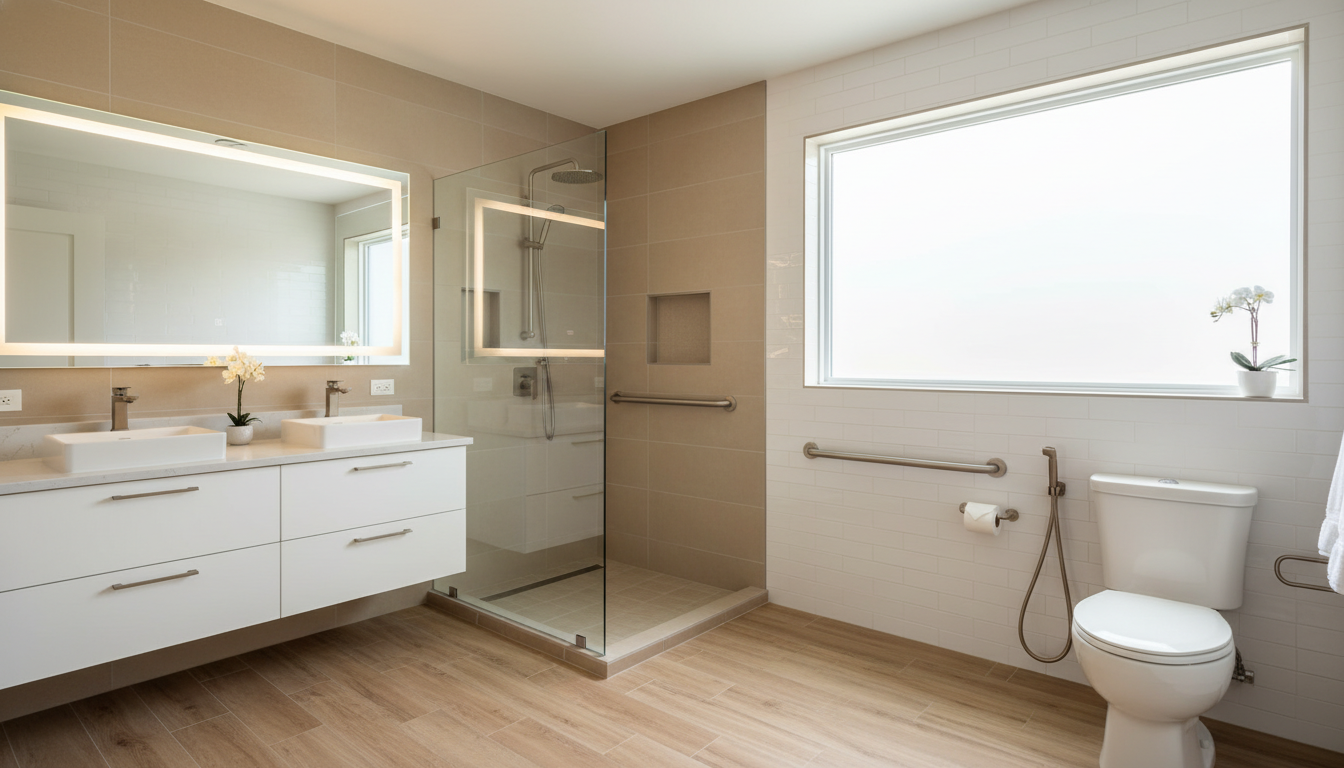
Aging in place bathroom design is the practice of creating or remodeling a bathroom so that it remains safe, functional, and comfortable as the user ages — from active middle age through advanced senior years. Unlike a reactive approach that adds safety features only after an injury or diagnosis, aging-in-place design anticipates future needs and builds them into the space from the start.
The concept draws heavily from universal design, a philosophy developed by architect Ronald Mace that calls for spaces usable by the widest range of people possible without the need for adaptation. When applied to bathrooms, universal design creates rooms that work for a 30-year-old marathon runner, a 70-year-old with arthritis, and a wheelchair user — all without looking institutional or clinical.
We have helped hundreds of families design bathrooms for aging in place, and the single most common regret we hear is: "I wish we had done this sooner." Families who proactively design for accessibility save an average of 40–60% compared to those who retrofit after a fall or health event, because the work is integrated into a planned renovation rather than added as an emergency modification.
Key Insight: The AARP reports that 77% of adults over 50 want to remain in their homes as they age, yet fewer than 10% of U.S. homes have the basic accessibility features needed for safe aging. Bathroom design is the single most impactful area where proactive planning can close this gap.
The 7 Universal Design Principles Applied to Bathrooms
Universal design bathroom principles provide the framework for every decision in an aging-in-place bathroom. These are not just theoretical guidelines — they translate directly into specific fixture choices, layout dimensions, and material selections that we will cover throughout this guide.
1. Equitable Use
The bathroom should be usable by people with diverse abilities without segregating or stigmatizing anyone. A curbless shower exemplifies this principle: it works for a wheelchair user, a parent carrying a toddler, an athlete with a temporary knee injury, and a senior with a walker. There is no "special" entrance or adaptation needed.
2. Flexibility in Use
The design accommodates a wide range of individual preferences and abilities. An adjustable shower head on a slide bar serves a 6-foot standing adult and a 5-foot seated senior equally well. Lever door handles work for someone with full grip strength and someone with severe arthritis.
3. Simple and Intuitive Use
The design is easy to understand regardless of experience, knowledge, language, or concentration level. Single-lever faucets with clear hot/cold markings eliminate confusion. Motion sensor bathroom lights remove the need to find a switch in the dark — critical for seniors with cognitive decline or nighttime disorientation.
4. Perceptible Information
The design communicates necessary information effectively regardless of ambient conditions or sensory abilities. This means contrasting colors between floor and walls to define boundaries, adequate bathroom lighting for elderly (minimum 50 foot-candles at task areas), and tactile indicators at transitions between wet and dry zones.
5. Tolerance for Error
The design minimizes hazards and the consequences of accidental actions. Anti-scald shower valves prevent burns if the user accidentally turns the handle too far. Rounded countertop edges reduce injury from bumps. Non-slip flooring catches missteps before they become falls.
6. Low Physical Effort
The design can be used efficiently and comfortably with minimum fatigue. A comfort height toilet (17–19 inches) reduces the physical effort of sitting and standing by 30–50% compared to a standard toilet. Grab bars provide leverage that substitutes for declining muscle strength. A shower bench seat eliminates the need to stand for the entire duration of a shower.
7. Size and Space for Approach and Use
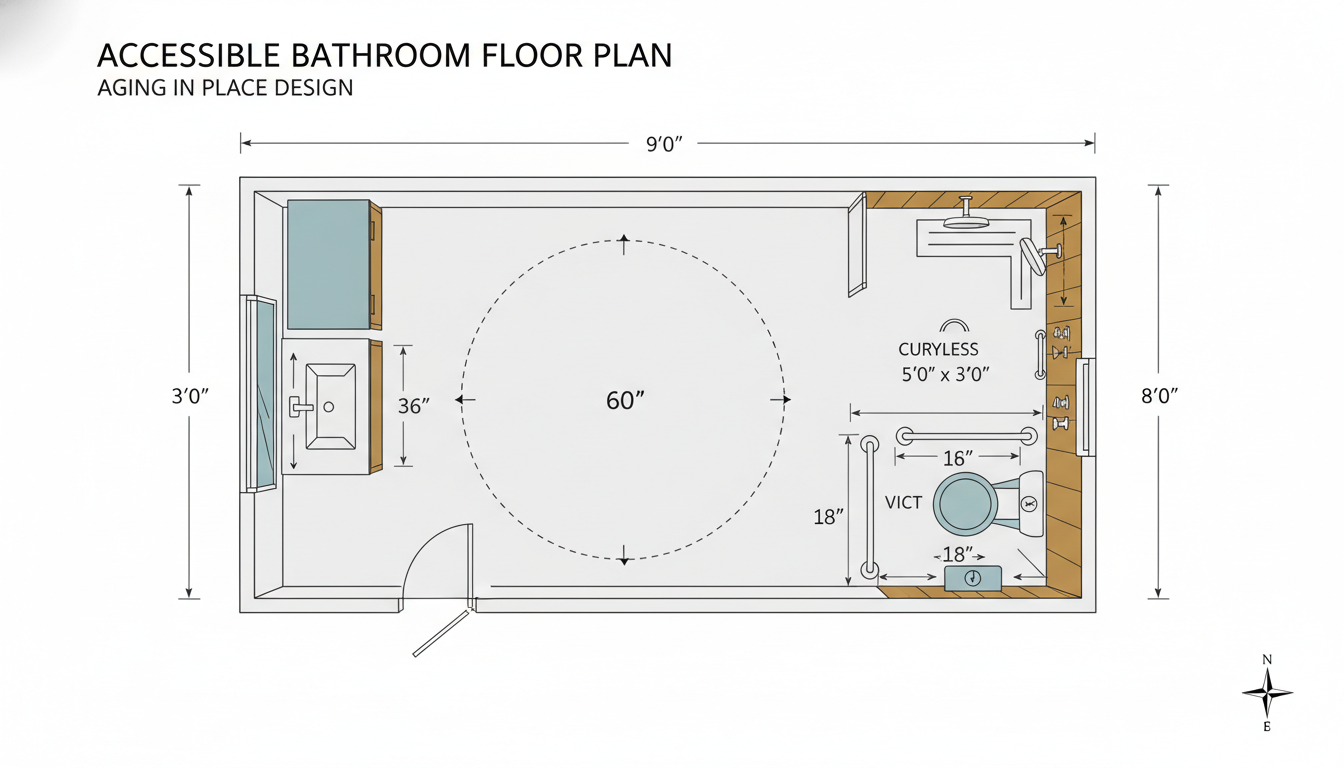
Appropriate size and space is provided for approach, reach, manipulation, and use regardless of body size, posture, or mobility. This translates to specific minimums: 60-inch wheelchair turning radius, 36-inch doorway width, 30×48-inch clear floor space at each fixture, and 18-inch minimum clearance beside the toilet.
Layout and Space Planning
The layout is the foundation of any accessible bathroom design. No amount of beautiful fixtures or safety products can compensate for a poorly planned layout that does not provide adequate clearance for mobility devices or safe movement patterns.
Minimum Dimensions
For a fully wheelchair accessible bathroom, the ideal minimum size is approximately 60 square feet (roughly 8×8 feet). This allows the 60-inch turning radius that wheelchair users need, plus adequate clearance at all fixtures. However, many effective aging-in-place bathrooms work within smaller footprints by using smart layout strategies.
If your bathroom is smaller than 60 square feet, focus on these priorities:
- Replace the bathtub with a curbless shower — this typically frees 10–15 square feet of usable floor space
- Use a pocket door or barn door instead of a swing door — this reclaims 8–10 square feet that the door arc occupies
- Install a wall-mounted or pedestal sink instead of a vanity cabinet — this creates knee clearance for seated approach and opens floor space
- Consider a wet room design where the entire floor slopes to a drain, eliminating the need for a separate shower enclosure
Doorway Design
The bathroom doorway is often the first barrier to accessibility. Standard interior doors are 24–28 inches wide, which is too narrow for most wheelchairs and many walkers. We recommend a minimum 32-inch clear opening, with 36 inches being ideal.
The door type matters as much as the width. A standard hinged door that swings into the bathroom creates two problems: it blocks floor space when open, and if a senior falls against it, rescuers cannot push the door open. The three best alternatives are:
- Pocket door: Slides into the wall, reclaiming all floor space. Best for new construction or major remodels where wall modification is feasible.
- Barn door: Slides along the outside wall. Easier to retrofit than a pocket door since it does not require wall modification, but it blocks wall space when open.
- Outward-swinging door: If a sliding option is not possible, a door that swings outward into the hallway allows rescue access and does not reduce bathroom floor space.
Whichever type you choose, replace round doorknobs with lever door handles. These can be operated with a closed fist, an elbow, or minimal grip strength — essential for seniors with arthritis or tremors.
Shower Design: The Most Critical Decision
The shower area is where the highest concentration of bathroom injuries occurs. The combination of wet surfaces, standing balance requirements, and temperature exposure makes it the most dangerous zone in the room. Your aging in place bathroom design should prioritize shower safety above all else.
Curbless (Zero-Threshold) Shower
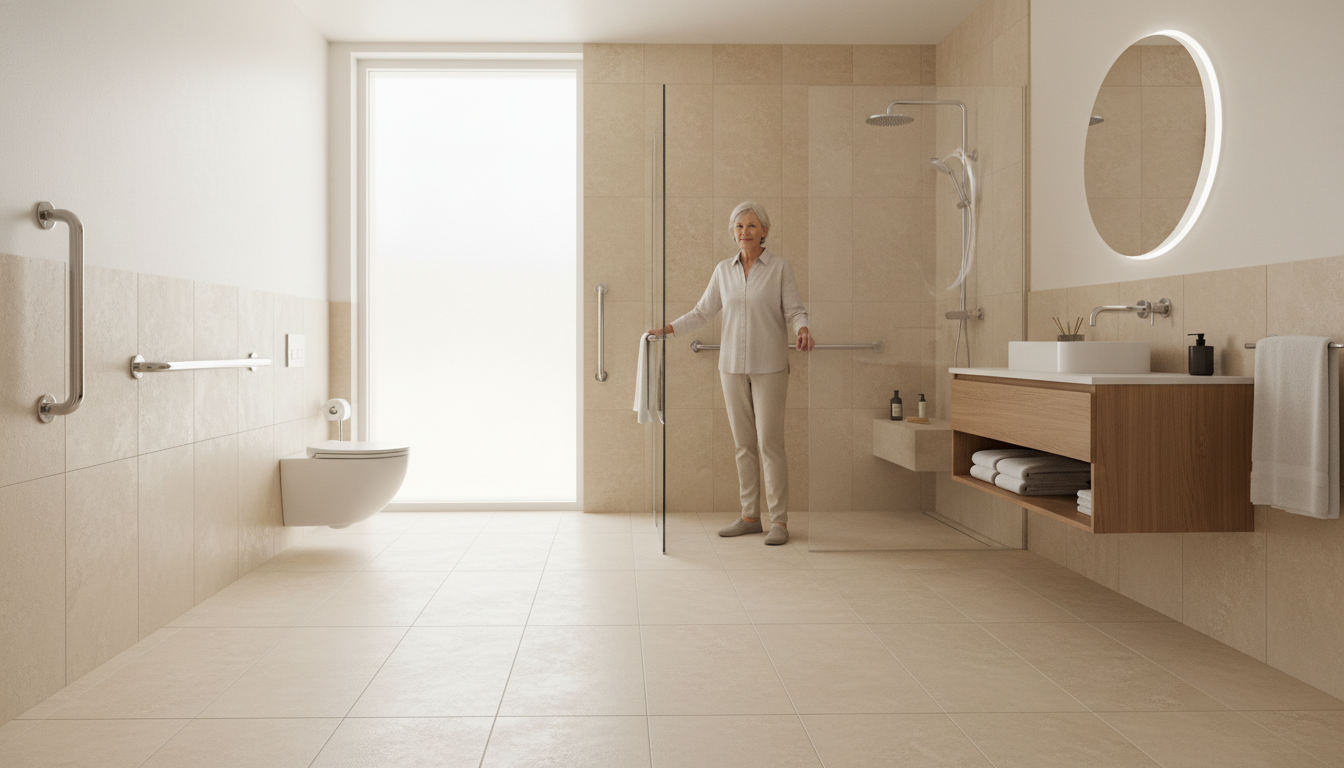
A zero threshold shower with no step-up is the gold standard for aging-in-place design. The floor transitions seamlessly from the bathroom into the shower area, eliminating the tripping hazard that causes thousands of senior injuries each year. This design is also called a barrier-free shower or roll-in shower.
Construction requires the bathroom floor to be recessed slightly in the shower area to create a gentle slope toward the drain (typically 1/4 inch per foot). A linear drain along one edge of the shower is preferred over a center drain because it allows the slope to go in one direction, which is more comfortable and safer for walking or rolling.
For complete shower comparisons, see our walk-in tub vs. roll-in shower guide.
Walk-in Tub Option
A walk-in tub is appropriate for seniors who specifically want or need soaking baths, particularly those who benefit from hydrotherapy for arthritis or chronic pain. Brands like Kohler, American Standard, and Safe Step offer models with built-in seats, grab bars, and therapeutic jet systems.
However, walk-in tubs have limitations that make them less versatile than curbless showers: they still require a 3–7 inch step-in, the user must wait 10–15 minutes for filling and draining while seated, and they are not wheelchair accessible. For a detailed cost and feature comparison, see our walk-in tub cost guide.
Essential Shower Fixtures
Every aging-in-place shower should include:
- Handheld shower head on an adjustable slide bar (60–72 inches tall) — allows both standing and seated use
- Shower bench seat — either a fold-down wall-mounted seat (saves space) or a freestanding shower chair (more portable)
- Anti-scald valve (thermostatic mixing valve) — limits water temperature to 120°F maximum to prevent burns
- Grab bars — minimum two: one vertical at the shower entry and one horizontal on the back wall at 33–36 inches height
- Non-slip flooring — DCOF rating of 0.60 or higher for the shower area, 0.80+ for wet room designs
Fixture Selection Guide
Choosing the right fixtures is where aging in place bathroom design balances safety with aesthetics. The best fixtures are those that enhance safety without looking clinical — they should feel like a design upgrade, not a medical accommodation.
Toilets
An ADA compliant toilet sits 17–19 inches from the floor to the top of the seat, compared to the standard 15 inches. This is marketed as "comfort height" or "right height" by manufacturers. The higher seat reduces the distance a senior must lower and raise their body, which is particularly important for those with knee replacements, hip problems, or general lower-body weakness.
We recommend a comfort height toilet with an elongated bowl (approximately 18.5 inches long) rather than a round bowl (16.5 inches). The elongated shape provides more sitting area and is easier to use for larger individuals. For budget-conscious projects, an elevated toilet seat or raised toilet seat with handles can be added to an existing toilet for $30–$80. For detailed comparisons, see our raised toilet seat vs. comfort height toilet guide.
Sinks and Vanities
The sink area must accommodate both standing and potentially seated use. A wall-mounted sink provides the most flexibility: it can be installed at any height (typically 34 inches for universal access) and leaves open knee space underneath for wheelchair approach. If storage is needed, choose a vanity with a recessed toe kick and removable cabinet doors that can be taken off later to create knee clearance.
Faucets should be single-lever or touchless. Lever-style faucets from brands like Moen and Delta require minimal grip strength and can be operated with one hand. Touchless faucets eliminate the need for gripping entirely but are more expensive and require battery or electrical connections.
Grab Bars That Look Like Design Features
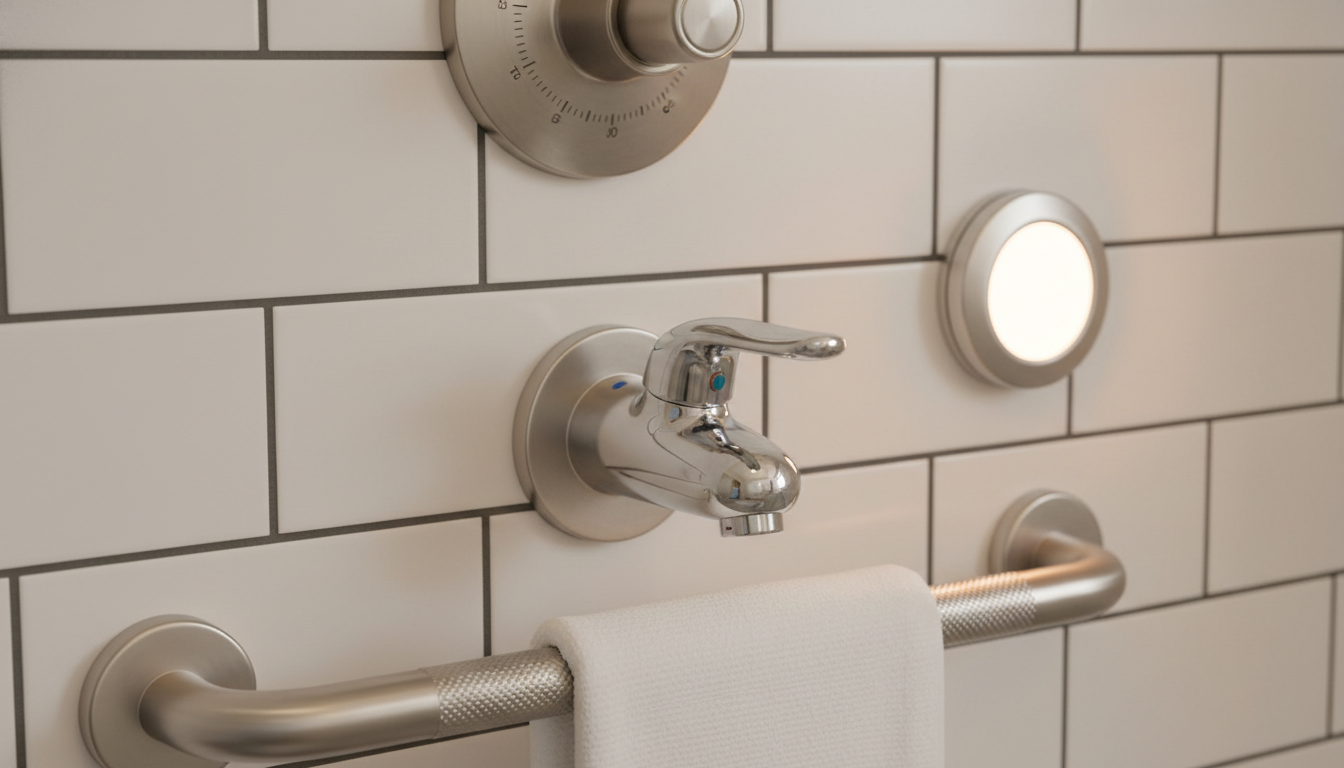
The biggest objection we hear about grab bars for elderly bathrooms is aesthetics. Families worry that chrome hospital-style bars will make the bathroom look institutional. The reality in 2026 is that grab bar design has advanced dramatically.
Manufacturers like Moen and Delta now offer ADA-compliant grab bars in brushed nickel, matte black, oil-rubbed bronze, and other designer finishes that match popular faucet and hardware lines. Some models are designed to double as towel bars or shelves, making them virtually indistinguishable from standard bathroom accessories.
For a complete guide to selection and installation, see our grab bar installation guide. The critical takeaway: even if you are not installing grab bars today, install blocking (reinforced wood backing) behind the drywall at all potential grab bar locations during any renovation. This invisible preparation costs under $50 during construction but saves $200–$400 per location if grab bars are needed later.
Lighting Design for Safety and Comfort
Bathroom lighting for elderly users requires a fundamentally different approach than standard bathroom lighting. Aging eyes need more light to see the same detail: a 60-year-old typically needs three times more light than a 20-year-old. At the same time, aging eyes are more sensitive to glare, meaning the light must be bright but diffused.
We recommend a layered lighting approach:
- Ambient lighting: Recessed LED ceiling lights providing 50–75 foot-candles of even, shadow-free illumination throughout the bathroom. Use warm white (2700K–3000K) to minimize harsh glare.
- Task lighting: Vertical LED strips or sconces flanking the mirror at eye level. This eliminates shadows on the face for grooming and medication reading. Minimum 300 lux at the mirror surface.
- Night lighting: Motion sensor bathroom lights positioned at baseboard level that activate automatically when someone enters. These provide enough light to navigate safely without the shock of full overhead lighting that can cause temporary blindness in dark-adapted eyes.
- Shower lighting: A dedicated waterproof (IP65-rated) recessed light in the shower area. Many seniors shower in dim conditions because the shower light was never installed or has burned out.
All bathroom light switches should be placed at 42–48 inches height (reachable from a wheelchair) and positioned at the entrance so they can be activated before entering the room. Illuminated or glow-in-the-dark switch plates are an inexpensive addition that helps seniors locate the switch in darkness.
Flooring and Surface Selection
The floor is the most interacted-with surface in the bathroom, and its slip resistance directly determines fall risk. We covered flooring materials in extensive detail in our non-slip bathroom flooring guide, but here are the key design considerations specific to an aging-in-place bathroom layout:
- Continuity: Use the same flooring throughout the bathroom to eliminate transition strips. If transitions are unavoidable, they must not exceed 1/4 inch in height (ADA standard) and should have a contrasting color for visibility.
- DCOF rating: Minimum 0.60 for general bathroom areas, 0.80+ for the shower zone. Look for slip-resistant bathroom tiles tested to ANSI A326.3 standards.
- Contrast: The floor color should contrast with walls and fixtures so that boundaries are clearly visible. Avoid all-white or all-dark color schemes that make it difficult to perceive depth and edges.
- Comfort: For seniors who are unsteady, flooring with some cushioning (luxury vinyl plank, rubber) provides both fall protection and comfort for bare feet.
- Maintenance: Choose materials that are easy to clean without requiring bending or scrubbing. Large-format tiles with minimal grout lines are easier to maintain than small mosaic tiles in non-shower areas.
Ventilation and Climate Control
Bathroom ventilation is a safety feature that is often overlooked in aging-in-place design. Excess moisture causes three problems for seniors: it makes floors slippery even when they have non-slip surfaces, it fogs mirrors reducing visibility, and it promotes mold growth that aggravates respiratory conditions common in older adults.
We recommend an exhaust fan rated at minimum 1 CFM per square foot of bathroom area (a 60 sq ft bathroom needs a 60 CFM fan). For aging in place bathroom design, choose a fan with a humidity sensor that activates automatically when moisture levels rise. This eliminates the need to remember to turn the fan on and off.
Temperature is another consideration. Seniors are more susceptible to hypothermia and discomfort from cold bathroom surfaces. Consider:
- Radiant floor heating: Electric mats installed beneath tile flooring provide gentle warmth that reduces the shock of stepping onto cold surfaces. Cost is typically $8–$15 per square foot installed.
- Towel warmer: A wall-mounted heated towel rack provides warm towels and supplemental bathroom heating. An easy retrofit at $150–$400 installed.
- Bathroom-rated space heater: A wall-mounted, timer-equipped heater that pre-warms the bathroom before use. Especially valuable in older homes with poor insulation.
Cost Planning and Prioritization
A complete aging in place bathroom design renovation can range from $5,000 to $30,000+ depending on the scope of work. For families who cannot fund a complete renovation at once, we recommend prioritizing modifications by their safety impact.
| Priority | Modification | Estimated Cost | Safety Impact |
|---|---|---|---|
| 1 (Critical) | Grab bars (5 locations) | $250–$1,000 | Prevents falls at highest-risk moments |
| 2 (Critical) | Non-slip flooring | $300–$1,200 | Eliminates primary fall cause |
| 3 (High) | Anti-scald valve + lever faucets | $150–$600 | Prevents burns, reduces effort |
| 4 (High) | Motion-sensor night lights | $30–$150 | Prevents nighttime falls |
| 5 (High) | Handheld shower head + bench | $100–$500 | Reduces standing time in shower |
| 6 (Medium) | Comfort height toilet | $200–$800 | Reduces sit-to-stand strain |
| 7 (Medium) | Improved lighting | $200–$800 | Improves visibility and orientation |
| 8 (Major) | Curbless shower conversion | $3,000–$15,000 | Eliminates shower entry hazard |
| 9 (Major) | Wider doorway + pocket door | $500–$2,500 | Enables wheelchair/walker access |
The first five priorities can be completed for under $3,000 and address the most dangerous hazards. Priorities 6 and 7 add another $400–$1,600. The major structural changes (priorities 8 and 9) are the most expensive but provide the most transformative accessibility improvements.
For financing options including Medicaid waivers, VA benefits, and local grants, see our financial assistance guide for senior home modifications. Medicare does not cover bathroom modifications directly, but some Medicare Advantage plans include home safety benefits — check with your specific plan. For more on what Medicare does and does not cover, see our Medicare home modifications guide.
Finding a CAPS-Certified Professional
A CAPS certified contractor (Certified Aging-in-Place Specialist) has completed specialized training from the National Association of Home Builders (NAHB) in accessible design, universal design principles, and the unique needs of aging clients. This certification is the single best indicator that a contractor understands the specific requirements of an aging-in-place bathroom.
To find a CAPS-certified professional near you:
- NAHB directory: Search the National Association of Home Builders website for CAPS-certified professionals in your area
- National Aging in Place Council: This organization maintains a directory of aging-in-place specialists including contractors, occupational therapists, and design consultants
- Area Agency on Aging: Your local AAA can often recommend contractors who have experience with senior home modifications
- AARP HomeFit Guide: AARP provides resources and contractor recommendations through their HomeFit program
When interviewing contractors, ask specifically about their experience with curbless shower construction, grab bar installation in tile, ADA clearance requirements, and non-slip flooring DCOF ratings. A general contractor who builds beautiful kitchens may not understand the precision required for a safe aging-in-place bathroom.
Pro Tip: Before hiring a contractor, schedule a home safety assessment with a certified professional. Our home safety assessment service evaluates your entire home, identifies the highest-priority modifications, and creates a detailed scope of work that you can take to contractors for competitive bids. This ensures you are getting quotes for exactly the right work — no more, no less.
Complete Aging-in-Place Bathroom Design Checklist
Use this comprehensive checklist when planning or evaluating your aging in place bathroom design. Each item reflects a universal design principle that contributes to long-term safety and usability.
Entry and Access:
- Doorway width: 32 inches minimum clear opening (36 inches preferred)
- Door type: pocket door, barn door, or outward-swinging
- Lever-style door handle
- No raised threshold at entry
- Light switch at entry point, 42–48 inches height
Shower Area:
- Curbless (zero-threshold) entry
- Minimum 36×36 inches interior (60×30 inches preferred for wheelchair)
- Non-slip floor with DCOF 0.80+
- Fold-down or removable shower bench
- Handheld shower head on adjustable slide bar
- Anti-scald thermostatic mixing valve
- Grab bars: vertical at entry, horizontal on back wall
- Dedicated waterproof shower light
- Linear drain for single-direction slope
Toilet Area:
- Comfort height (17–19 inches)
- 18 inches minimum clearance on one side
- Grab bar on wall side
- 30×48 inches clear floor space for approach
- Toilet paper holder within easy reach without leaning
Sink and Vanity:
- Wall-mounted or open-base sink with knee clearance
- Lever-style or touchless faucet
- Mirror extending down to 40 inches from floor (or tilted)
- Accessible storage (no high cabinets requiring reaching)
Flooring:
- Non-slip surface throughout (DCOF 0.60+ general, 0.80+ shower)
- Continuous material — no transitions if possible
- Contrasting color at any transitions
- No loose rugs or mats without non-skid backing
Lighting:
- 50–75 foot-candle ambient lighting
- Task lighting at mirror
- Motion-sensor night lights at baseboard level
- Waterproof light in shower area
- Illuminated or glow-in-dark switch plates
Climate and Comfort:
- Humidity-sensing exhaust fan (1 CFM per sq ft minimum)
- Supplemental heating (radiant floor, towel warmer, or wall heater)
Emergency Preparedness:
- Emergency call system accessible from toilet and shower
- Door unlockable from outside
- Blocking installed at all potential future grab bar locations
For a printable version and additional room-by-room checklists, see our senior bathroom safety checklist and our broader DIY home safety assessment guide.
Ready to Design Your Aging-in-Place Bathroom?
A professional home safety assessment is the ideal starting point. We evaluate your current bathroom, identify priority modifications, and provide a detailed design and scope-of-work document you can use with any contractor.
Explore Home Safety Assessments About Margaret Chen
Certified Aging-in-Place Specialist & Senior Care Advisor
CAPS-certified senior care advisor with 15+ years helping families plan for safe aging at home. Margaret specializes in universal design bathroom planning and accessible home modifications for seniors at every mobility level.
Related Articles
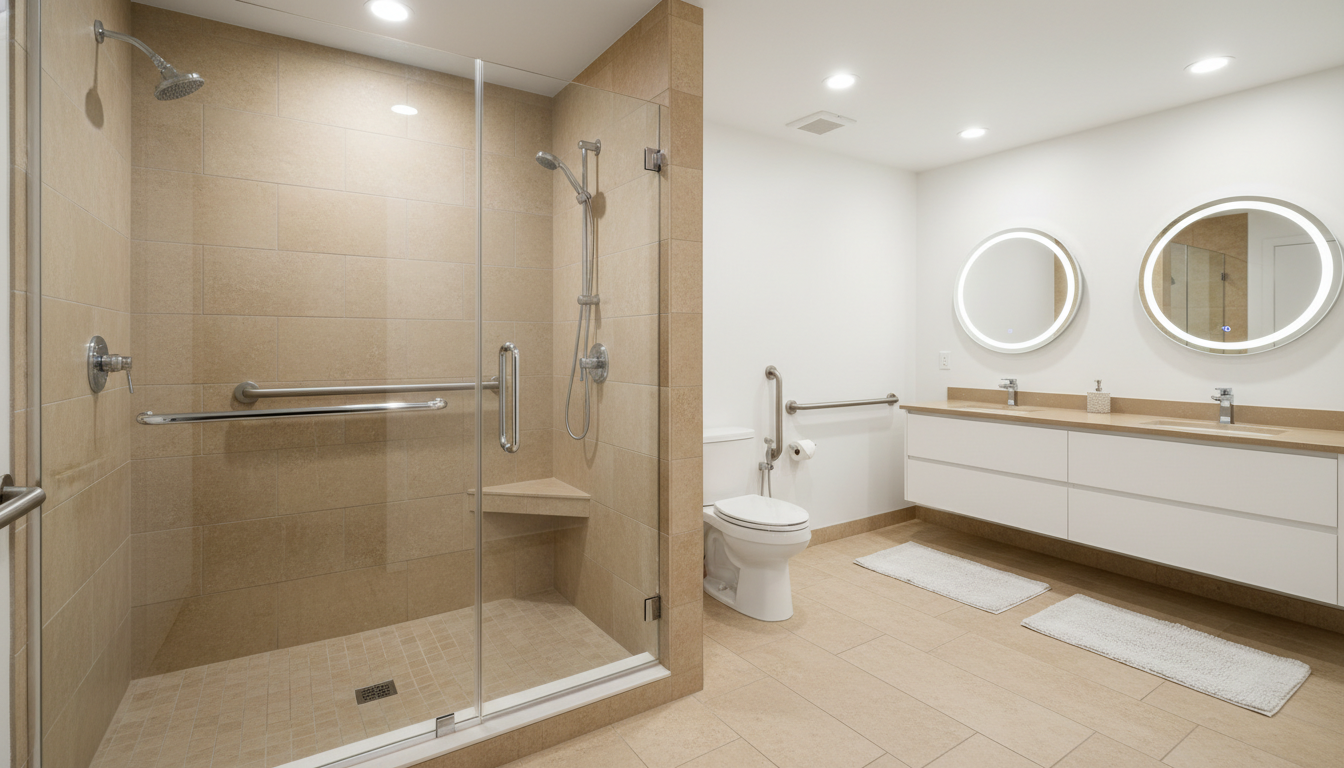
Bathroom Remodel for Elderly: Complete Aging-in-Place Renovation Guide 2026
Complete guide to bathroom remodel for elderly including walk-in showers, grab bars, ADA-compliant fixtures, and financing options.
Non-Slip Bathroom Flooring for Elderly: Complete Safety Guide 2026
Expert guide to non-slip bathroom flooring including DCOF ratings, material comparisons, and ADA-compliant options for aging in place.

Senior Bathroom Safety Checklist: Complete Guide
Room-by-room bathroom safety checklist covering grab bars, flooring, lighting, and accessibility modifications for elderly independence.