3-Wheel vs 4-Wheel Mobility Scooter: Which Is Better & Safer?
Choosing between a 3-wheel and 4-wheel mobility scooter comes down to where you will use it most, how stable you need to feel, and what terrain you will encounter. Here is the full breakdown.

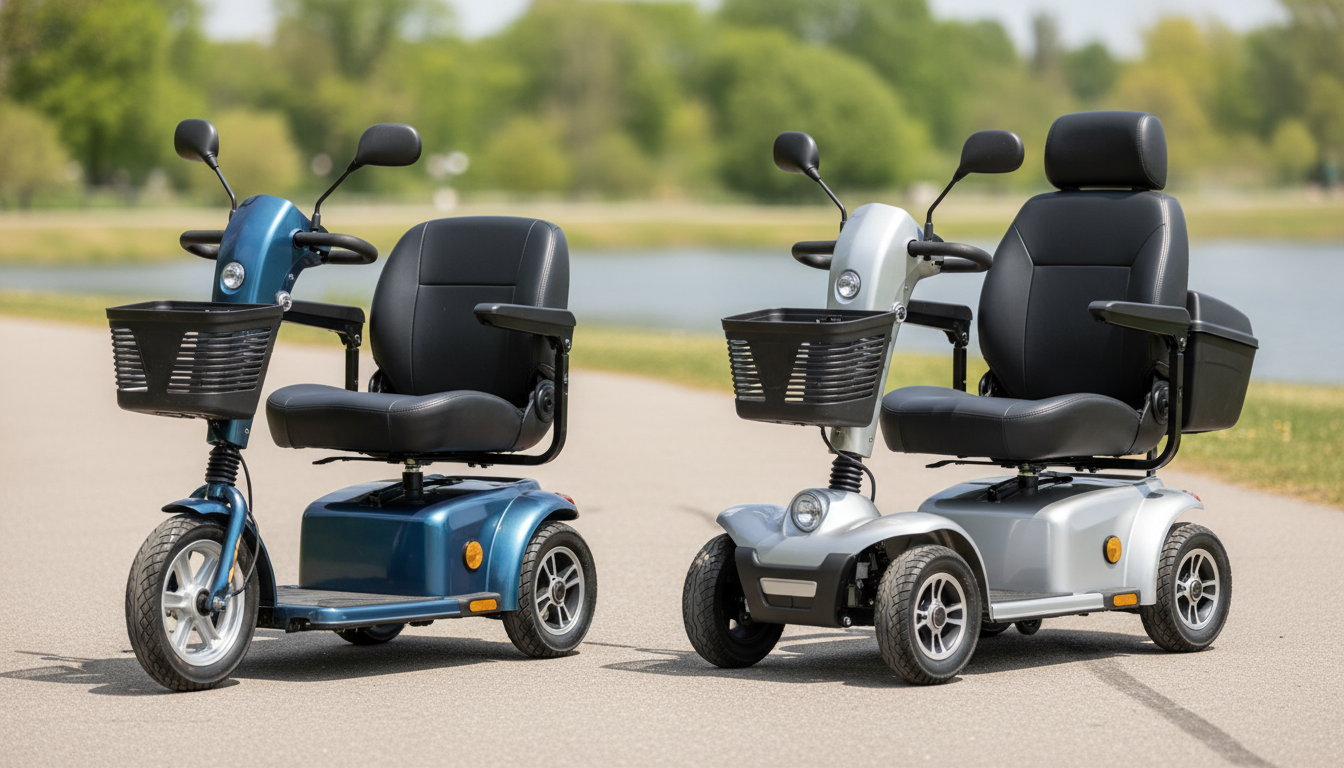
3-Wheel vs 4-Wheel at a Glance
Before diving into the details, here is a side-by-side comparison of the two scooter types across every factor that matters for seniors.
| Feature | 3-Wheel | 4-Wheel |
|---|---|---|
| Stability | Good on flat surfaces; less stable on slopes and uneven ground | Excellent on all surfaces including slopes and rough terrain |
| Turning Radius | Tighter (32–40″) | Wider (50–60″) |
| Weight Capacity | Typically 220–300 lbs | Typically 265–500 lbs |
| Terrain | Best on smooth, flat surfaces | Handles grass, gravel, slight inclines |
| Indoor Use | Excellent — navigates tight spaces easily | Good but requires wider doorways and hallways |
| Outdoor Use | Limited — sidewalks and paved paths only | Excellent — handles most outdoor environments |
| Price Range | $450–$1,500 | $500–$2,800 |
| Best For | Indoor use, tight spaces, lighter users | Outdoor use, uneven terrain, heavier users, daily dependence |
Are 3-Wheel Mobility Scooters Safe?
Yes, 3-wheel mobility scooters are safe — with caveats. A 3-wheel scooter has a single front wheel and two rear wheels, which creates a narrower front wheelbase compared to a 4-wheel design. On flat, smooth indoor surfaces like tile, hardwood, or low-pile carpet, a 3-wheel scooter is perfectly stable and safe for most users.
However, the tipping risk increases meaningfully in certain situations. Slopes, uneven ground, and higher speeds all amplify the stability disadvantage of that single front wheel. Side slopes (where one side of the path is higher than the other) are particularly problematic because the triangular wheel base has less resistance to lateral tipping.
Many manufacturers add anti-tip wheels — small caster wheels mounted near the rear of the frame — to reduce the risk. These help, but they do not eliminate the underlying physics of a three-point contact design. They are a safety net, not a solution.
For seniors with balance concerns, neurological conditions, or who weigh over 250 pounds, a 4-wheel scooter is the safer choice. The wider, four-point wheelbase distributes weight more evenly and resists tipping forces from any direction.
One terminology note: a “trike mobility scooter” is simply another term for a 3-wheel mobility scooter. If you see that phrase while shopping, it refers to the same three-wheel configuration discussed here.
Best 3-Wheel Mobility Scooters for 2026
After testing and reviewing dozens of models, these are the three best 3-wheel scooters for seniors in 2026.
#1 Vive Health 3-Wheel Scooter — Best Overall 3-Wheel. The Vive 3-Wheel delivers the tightest turning radius in its class at just 32 inches, making it ideal for navigating tight hallways and small apartments. It carries up to 250 pounds, features LED headlights and taillights for visibility, and includes a padded swivel seat for easy mounting and dismounting. At approximately $1,500, it represents the best balance of quality, features, and maneuverability in the 3-wheel category.
#2 Drive Medical Scout 3. A reliable mid-range option that has been a staple in the mobility scooter market for years. The Scout 3 supports up to 300 pounds — impressive for a 3-wheel design — and offers straightforward disassembly for transport. At around $1,000, it is a solid choice for seniors who want dependable performance without premium pricing.
#3 Pride Mobility Go-Go Elite Traveller 3-Wheel. The Go-Go Elite Traveller is built for travel. It folds compactly, is airline friendly, and weighs less than most competitors. With a price around $1,300, it is the best choice for seniors who frequently travel and need a scooter that can go with them.
Best 4-Wheel Mobility Scooters for 2026
For seniors who need maximum stability and versatility, these are our top 4-wheel picks.
#1 Vive Health 4-Wheel Scooter — Best Overall 4-Wheel. The Vive 4-Wheel is our top recommendation for most seniors. It supports 300 pounds, delivers a 15-mile range on a single charge, and features full suspension for a smooth ride on any surface. LED lights front and rear provide safety in low-light conditions. At approximately $1,800, it is a premium investment that pays for itself in durability and ride quality. For a detailed look at how Vive compares to budget alternatives, see our Segmart vs Vive Mobility comparison.
#2 Pride Mobility Maxima 4-Wheel. Built for heavier users, the Maxima supports up to 500 pounds with a reinforced frame and wider seat. At around $2,800, it is the go-to heavy-duty option for bariatric users who need maximum weight capacity without sacrificing comfort or range.
#3 Segmart 4-Wheel. The Segmart is our budget pick at $500 to $700. It supports 265 pounds and provides adequate performance for light indoor and outdoor use. Build quality is noticeably lower than Vive or Pride — thinner steel tubing, less seat padding, shorter battery life — but as an entry point for seniors exploring whether a scooter fits their lifestyle, it is hard to beat on price.
Zero Turn vs Standard Turning Radius
Turning radius is one of the most important specs for indoor scooter use, and it is where 3-wheel scooters traditionally hold their advantage.
Standard 3-wheel scooters typically offer a turning radius of 32 to 40 inches. Standard 4-wheel scooters need 50 to 60 inches to complete a full turn. In a narrow hallway or small kitchen, that difference matters enormously.
However, zero-turn technology is changing the equation. Zero-turn scooters can rotate 360 degrees in approximately 33 inches regardless of wheel count, effectively eliminating the turning radius advantage of 3-wheel designs. If indoor maneuverability is your primary concern but you want 4-wheel stability, a zero-turn 4-wheel model gives you the best of both worlds.
For a detailed look at zero-turn models, specs, and pricing, see our complete guide to zero-turn mobility scooters.
Which Should You Choose?
Here is the decision framework we use when helping families choose between 3-wheel and 4-wheel scooters.
- Primarily indoor use in tight spaces → 3-wheel scooter. The tighter turning radius makes daily navigation easier in apartments, small homes, and crowded facilities.
- Outdoor use, uneven terrain, or heavier user → 4-wheel scooter. The wider wheelbase and higher weight capacities handle real-world conditions safely.
- Both indoor and outdoor use → 4-wheel scooter. When in doubt, 4-wheel is the safer default because it handles both environments adequately, while a 3-wheel scooter struggles outdoors.
- Frequent travel → Folding 3-wheel scooter. Models like the Pride Go-Go Elite Traveller are specifically designed for portability and airline compatibility.
For most aging-in-place seniors who will use their scooter daily across various settings, a 4-wheel model is the smarter investment. The stability advantage matters more as balance and strength naturally decline with age.
For a comprehensive look at all scooter types, features, and buying considerations, visit our complete mobility scooter guide. You can also learn more about reducing fall risks throughout your home, or contact us for personalized recommendations.
Need Help Choosing?
Our mobility specialists can help you find the right scooter based on your living space, lifestyle, and mobility needs.
Explore Mobility Scooters
About James Wilson
Home Safety Specialist & Accessibility Consultant
Certified home safety specialist with 10+ years designing accessible living spaces for seniors and individuals with mobility challenges.