Dementia Aging in Place: How to Balance Home Upkeep Costs vs. Care Budget (2026)
Complete cost breakdown for dementia aging in place — home upkeep, in-home dementia care, safety modifications, and smart home technology for elderly vs. memory care facility costs. Includes Medicare, Medicaid, VA benefits, and dementia care financial planning strategies.

The Real Cost of Dementia Aging in Place
When a loved one is diagnosed with dementia, the question of where they will live is quickly followed by the question of how much it will cost. For most families, aging in place — remaining in the family home — is the preferred choice. But the financial reality of dementia aging in place is more complex than simply comparing rent at a memory care facility to a mortgage payment.
The true cost involves two competing budgets: home upkeep costs (maintenance, modifications, property taxes, and utilities) and the care budget (a home health aide, adult day services, medical alert systems, and eventually 24-hour home care). As dementia progresses, the care budget grows while the home upkeep costs remain relatively constant — and families must decide when the scales tip.
According to the Alzheimer's Association, the average lifetime cost of care for someone with dementia exceeds $377,000, with roughly 70% of that burden falling on families through unpaid caregiving and out-of-pocket expenses. This guide breaks down exactly how much dementia care costs at home versus a facility, helps you build a realistic care budget plan, and identifies every funding source available to stretch your dollars further.
Home Upkeep Costs: What You're Already Spending
Before adding dementia-specific care expenses, most families underestimate what it costs simply to maintain a home that is safe and functional for an elderly person. Here is a realistic breakdown of home upkeep costs for a typical single-family home where a senior is aging in place.
| Expense Category | Monthly Cost | Annual Cost |
|---|---|---|
| Mortgage / Rent | $0 - $1,800 | $0 - $21,600 |
| Property Taxes | $200 - $600 | $2,400 - $7,200 |
| Homeowner's Insurance | $100 - $300 | $1,200 - $3,600 |
| Utilities (electric, gas, water) | $200 - $400 | $2,400 - $4,800 |
| Home Maintenance & Repairs | $150 - $350 | $1,800 - $4,200 |
| Lawn Care / Snow Removal | $50 - $200 | $600 - $2,400 |
| Groceries & Household Supplies | $300 - $600 | $3,600 - $7,200 |
For a homeowner with a paid-off mortgage, the baseline home upkeep costs run roughly $1,000 to $2,450 per month — or $12,000 to $29,400 per year. For renters or those still paying a mortgage, add $800 to $1,800 per month on top of that. These costs remain relatively flat as dementia progresses, which is actually one of the biggest financial advantages of aging in place vs. assisted living — the housing cost is predictable.
Dementia Care Budget: What In-Home Care Actually Costs
This is where the budget gets challenging. Dementia care costs scale dramatically with disease progression. In early stages, a few hours of weekly support may suffice. By late stages, families face the cost of 24-hour home care — which can easily exceed the cost of a memory care facility.
 Planning your dementia care budget early helps families avoid financial crisis as care needs increase
Early-Stage Dementia (Years 1-3)
In the early stages, your loved one may need help with medication management, meal preparation, and light housekeeping. A home health aide visiting 10-20 hours per week is typically sufficient.
- Home health aide (part-time): $600 - $1,400 per month (at $30-$35/hour)
- Adult day services: $350 - $900 per month (2-3 days/week at $75-$100/day)
- Medication management tools: $30 - $80 per month (smart pill dispensers, pharmacy services)
- Occupational therapy assessment: $150 - $300 (one-time, often covered by Medicare)
Early-stage monthly care budget: $980 - $2,680
Mid-Stage Dementia (Years 3-6)
As the disease progresses, your loved one will need more hands-on assistance with bathing, dressing, and daily activities. Wandering behavior and fall prevention become critical concerns. Most families increase in-home dementia care to 30-50 hours per week and add safety monitoring.
- Home health aide (extended): $3,600 - $7,000 per month (30-50 hrs/week)
- Adult day services (dementia-specific): $800 - $1,500 per month (4-5 days/week)
- Medical alert system with fall detection: $30 - $60 per month
- Caregiver respite care: $200 - $500 per month (weekend relief for family caregivers)
- Incontinence supplies: $50 - $150 per month
Mid-stage monthly care budget: $4,680 - $9,210
Late-Stage Dementia (Years 6+)
In late stages, 24-hour home care is often necessary. This is the tipping point where many families must make the difficult home care vs. memory care decision based on finances.
- 24-hour home care (live-in or rotating aides): $10,000 - $20,000 per month
- Skilled nursing visits: $200 - $500 per month (wound care, medical monitoring)
- Durable medical equipment: $100 - $300 per month (hospital bed, wheelchair, lift)
- Medical supplies & medications: $200 - $600 per month
Late-stage monthly care budget: $10,500 - $21,400
Key Insight: The average cost of memory care per month in the U.S. is $5,369 (Genworth 2025 data). When 24-hour home care costs exceed $10,000 per month, a memory care facility may actually be the more affordable option — though many families still prefer the familiarity and personalization of home care. The decision is never purely financial.
Aging in Place vs. Memory Care: The Full Cost Comparison
Is aging in place cheaper than assisted living for someone with dementia? The answer depends entirely on the stage of the disease and how much care is needed. Here is a side-by-side cost comparison aging in place vs. a memory care facility at each stage.
| Cost Category | Early Stage (Home) | Mid Stage (Home) | Late Stage (Home) | Memory Care Facility |
|---|---|---|---|---|
| Housing | $1,000 - $2,450 | $1,000 - $2,450 | $1,000 - $2,450 | Included |
| Care / Staffing | $980 - $2,680 | $4,680 - $9,210 | $10,500 - $21,400 | Included |
| Meals | $300 - $600 | $300 - $600 | $300 - $600 | Included |
| Medical / Supplies | $180 - $380 | $280 - $710 | $500 - $1,400 | $200 - $500 |
| Total Monthly | $2,460 - $6,110 | $6,260 - $12,970 | $12,300 - $25,850 | $5,369 - $8,500 |
| Total Annual | $29,520 - $73,320 | $75,120 - $155,640 | $147,600 - $310,200 | $64,428 - $102,000 |
The numbers tell a clear story: aging in place with dementia is significantly cheaper in the early stages and roughly comparable in mid stages. By late stages, home care costs can be 2-3x more expensive than a memory care facility — unless you have family caregivers who can reduce the paid care hours or qualify for Medicaid waiver home care programs.
Home Modifications for Dementia Safety
Making a home safe for someone with dementia requires specific accessibility modifications beyond standard aging in place upgrades. These are one-time investments that reduce ongoing care costs by preventing falls, wandering incidents, and accidents.
Essential Modifications
| Modification | Cost Range | Purpose |
|---|---|---|
| Grab bars installation | $100 - $500 | Fall prevention in bathroom, hallways |
| Walk-in tub installation | $3,000 - $15,000 | Safe bathing, reduced fall risk |
| Stair lift | $2,500 - $12,000 | Safe multi-level access |
| Door alarms & locks | $50 - $300 | Wandering prevention |
| Automatic stove shut-off | $80 - $400 | Fire prevention |
| Non-slip flooring | $500 - $3,000 | Fall prevention throughout home |
| Improved lighting | $200 - $1,000 | Reduce confusion, prevent falls |
| Wheelchair ramp | $1,000 - $8,000 | Accessibility for late-stage mobility |
A comprehensive home safety assessment by a geriatric care manager or certified occupational therapy professional will identify exactly which modifications your home needs. Most families spend $5,000 to $25,000 on the initial round of home modifications, with the total home modification cost breakdown depending on the home's age and existing accessibility features. See our home safety assessment guide for a room-by-room walkthrough.
Smart Home Technology for Dementia Safety
Smart home technology for elderly individuals with dementia has advanced dramatically. These senior safety devices can reduce the need for paid supervision hours, effectively lowering your monthly care budget.
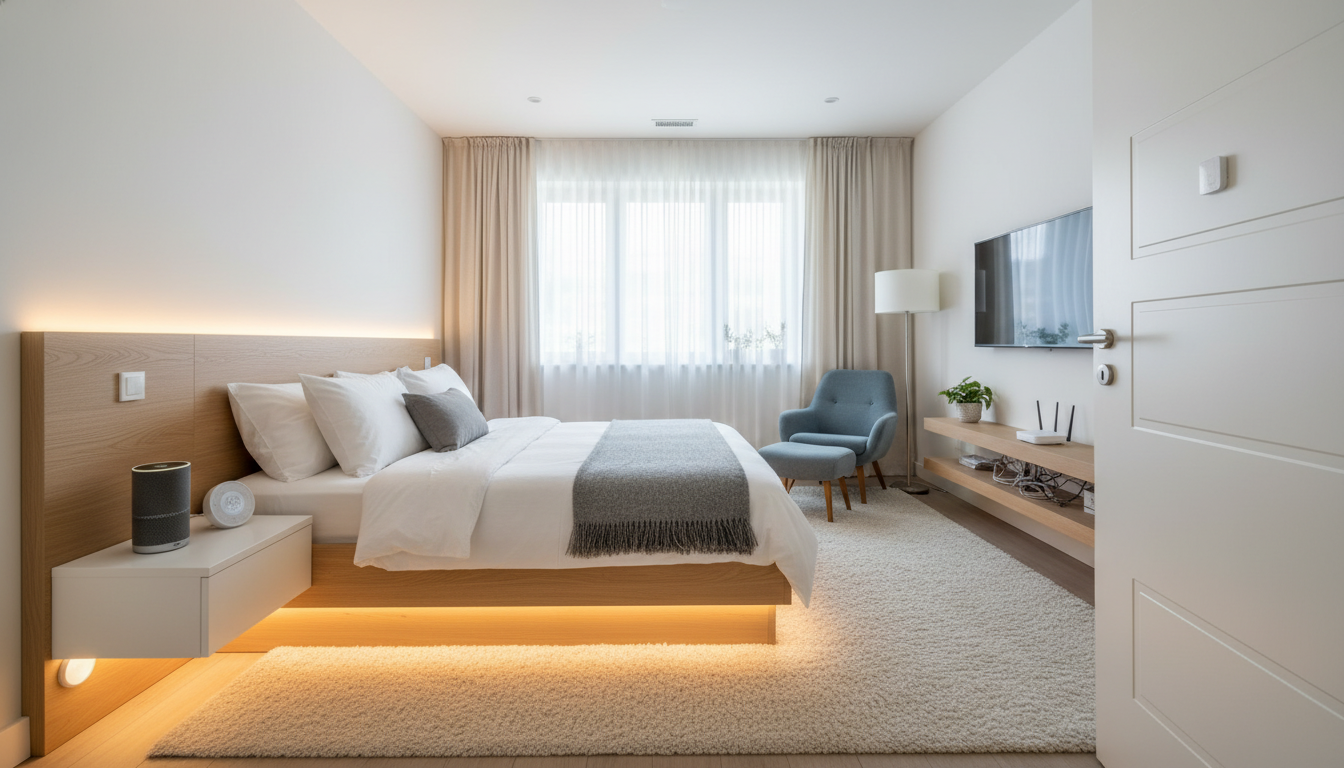 Smart home technology can reduce paid care hours by providing automated monitoring between aide visits
- Smart pill dispensers: $30 - $80/month — automated medication reminders and dispensing, alerts caregivers to missed doses
- Medical alert systems with fall detection: $30 - $60/month — automatic fall detection devices that alert emergency services
- GPS tracking devices: $20 - $50/month — wearable or shoe-insert trackers for wandering prevention
- Smart home monitoring systems: $25 - $75/month — motion sensors, door sensors, activity monitoring without cameras
- Video doorbells & smart locks: $10 - $25/month — prevent unauthorized entry and exit
- Automatic night lights: $20 - $50 (one-time) — motion-activated path lighting to prevent nighttime falls
A well-designed smart home monitoring setup costs $100 to $250 per month but can reduce the need for paid supervision by 5-15 hours per week — saving $600 to $2,100 monthly in home health aide costs. For more on privacy-friendly monitoring options, see our guide to camera-free systems.
How to Pay: Insurance, Medicare, Medicaid & VA Benefits
Understanding what home modifications Medicare covers and which programs fund in-home dementia care is critical to stretching your care budget. Here is a breakdown of every major funding source.
Medicare Coverage for Dementia
Medicare coverage for dementia is limited but important. Medicare does not pay for long-term custodial care (bathing, dressing, supervision). However, it does cover:
- Skilled nursing visits (intermittent, medically necessary)
- Occupational therapy assessments for home safety
- Durable medical equipment (hospital beds, wheelchairs, walkers)
- Some home health aide services when paired with skilled nursing orders
- Hospice care in late-stage dementia (covers nearly all care costs)
For a detailed breakdown, see our guide to what Medicare covers for home modifications. Medicare Advantage plans often include supplemental benefits like meal delivery, transportation, and even home modification allowances of $1,000 to $3,000 per year — check your specific plan.
Medicaid Waiver Programs for Home Care
Medicaid waiver home care programs are the single most valuable funding source for families managing dementia aging in place. These Home and Community-Based Services (HCBS) waivers can pay for:
- Personal care aide services (bathing, dressing, meals)
- Adult day services for dementia
- Caregiver respite care (giving family caregivers a break)
- Home modifications for safety and accessibility
- Assistive technology and senior safety devices
Eligibility is income-based and varies by state. In many states, a person can qualify for Medicaid HCBS waivers with income up to 300% of the federal SSI level (approximately $2,829/month in 2026). Waiting lists exist in some states, so apply as early as possible — even if your loved one does not yet need extensive care.
Long-Term Care Insurance
Is long-term care insurance worth it for dementia? If your loved one already has a policy, it may be the most valuable financial asset in your dementia care financial planning toolkit. Most long-term care insurance policies cover:
- In-home dementia care (home health aides, personal care)
- Adult day services
- Memory care facility costs
- Some cover home modifications and assistive devices
Benefits typically range from $150 to $350 per day with a lifetime maximum of $150,000 to $500,000. If your loved one does not have existing coverage, purchasing a new policy after a dementia diagnosis is generally not possible — insurers exclude pre-existing cognitive conditions.
Veterans Benefits for Dementia Care
Veterans benefits for dementia home care are substantial and often underutilized. The VA offers:
- Aid and Attendance pension: Up to $2,431/month for veterans (or $1,564/month for surviving spouses) who need help with daily activities
- HISA grants: Up to $6,800 for home modifications related to service-connected disabilities
- Home-Based Primary Care: Free in-home medical visits for eligible veterans
- Respite care: Up to 30 days per year of free caregiver relief
The Aid and Attendance benefit alone can cover $29,172 annually — enough to fund part-time home health aide services through the mid stages of dementia.
Tax Deductions for Elderly Home Modifications
Tax deductions for elderly home modifications can recover a significant portion of your spending. Medical expense deductions apply to home modifications prescribed by a physician, including walk-in tub installations, stair lifts, grab bars, and wheelchair ramps. In-home care costs also qualify as medical expenses when provided by a licensed home care agency. Total medical expenses must exceed 7.5% of adjusted gross income to be deductible — a threshold most families with dementia care costs easily surpass.
Financial Planning Strategies for Dementia Care
Effective dementia care financial planning starts the moment you receive a diagnosis — even if your loved one is still largely independent. Here are the strategies that make the biggest difference.
Using Home Equity to Fund Care
For homeowners, a reverse mortgage or home equity line of credit can convert home equity into care funding. A reverse mortgage for senior care provides tax-free income with no monthly payments — the loan is repaid when the home is sold. This works particularly well for families planning to age in place through mid stages and then transition to a facility, as the home sale covers the reverse mortgage balance plus facility deposits.
How to Pay for Dementia Care Without Insurance
If your loved one lacks long-term care insurance, the path forward involves layering multiple funding sources:
- Apply for Medicaid HCBS waivers immediately — even before care is needed, to get on waiting lists
- File for VA benefits if your loved one or their spouse is a veteran
- Maximize Medicare benefits by working with a geriatric care manager who knows how to document medical necessity
- Explore home modification grants through your Area Agency on Aging, USDA, and nonprofit organizations
- Use the tax deduction aggressively — track every medical expense, modification cost, and care payment
- Restructure the home budget — reduce discretionary spending and redirect those dollars to the care budget
- Consider adult day services as a cost-effective bridge: at $75-$100/day, an adult day services dementia program costs 60-70% less than equivalent hours of in-home aide care
When Home Care Stops Making Financial Sense
There is a cost crossover point where aging in place becomes more expensive than a memory care facility. Based on national averages, this typically happens when:
- Your loved one needs more than 50-60 hours per week of paid care
- Monthly in-home dementia care costs exceed $8,000 to $10,000
- You require overnight supervision or multiple daily aide shifts
- Safety incidents (falls, wandering, kitchen fires) become frequent despite home modifications and smart home technology
This does not mean you must move to a facility. Many families choose to continue dementia aging in place even when it costs more, because the emotional benefits — familiar surroundings, personalized care, preserved routines — are worth the premium. The key is making that choice with clear financial data rather than discovering the costs after savings are depleted.
For guidance on recognizing when the transition is necessary beyond just costs, see our article on the 8 signs it's time for assisted living.
Building Your Dementia Aging in Place Budget: Step-by-Step
Here is our recommended approach to how to calculate aging in place costs and build a realistic budget that accounts for dementia progression.
- Schedule a home safety assessment: A certified specialist will evaluate your home and provide a home modification cost breakdown specific to your situation.
- Get a dementia staging evaluation: Understanding the current stage helps predict care needs and costs for the next 2-3 years.
- Calculate your baseline home costs: Add up mortgage/rent, taxes, insurance, utilities, maintenance, and food. This is your fixed floor.
- Estimate current care needs: How many hours per week of paid care does your loved one need right now? Multiply by your local home health aide cost ($25-$35/hour in most markets).
- Project care escalation: Plan for a 20-30% annual increase in care hours as dementia progresses. Budget for where you will be in 2-3 years, not just today.
- Inventory all funding sources: List every dollar available from Medicare, Medicaid, VA benefits, long-term care insurance, Social Security, pensions, savings, and home equity.
- Identify the crossover point: At what monthly cost does a memory care facility become cheaper than home care? Knowing this number in advance prevents crisis decision-making.
- Build a modification investment plan: Prioritize one-time home modifications that reduce ongoing care costs — smart home monitoring, fall prevention upgrades, and bathroom accessibility improvements deliver the best ROI.
- Consult a financial planning specialist experienced in elder care to structure asset protection, Medicaid planning, and tax strategies.
Pro Tip: Use our Home vs. Facility Cost Calculator to run the numbers for your specific situation. Input your home costs, estimated care hours, and local rates to see a month-by-month projection of aging in place vs. memory care costs over 5 years.
Making the Right Financial Decision for Your Family
Dementia aging in place is not just a financial decision — it is an emotional, medical, and logistical one. But the financial foundation must be solid for the rest to work. Families who plan ahead, apply for every available benefit, and invest strategically in home modifications and smart home technology can extend the period of affordable home care by years.
The most common mistake we see is waiting too long to plan. By the time 24-hour home care is needed, families have often missed Medicaid application windows, depleted savings on avoidable costs, and foregone tax deductions worth thousands of dollars. Start building your care budget plan today — even if your loved one is still in the earliest stages of cognitive change.
The numbers are real, but so are the dementia care options. Between Medicare, Medicaid waivers, VA benefits, home modification grants, smart technology, and strategic financial planning, most families can find a path that keeps their loved one safe, comfortable, and at home — for far longer than they initially thought possible.
Ready to Take Action?
Get a professional evaluation of your home's safety and accessibility needs for dementia aging in place.
Schedule a Home Safety Assessment About Margaret Chen
Certified Aging-in-Place Specialist (CAPS)
CAPS-certified specialist helping families create safe, comfortable living environments for seniors aging at home. Expert in dementia-specific home modifications and care planning.
Related Articles
Assisted Living vs. Home Care: True Cost Comparison for 2026
Detailed cost comparison of assisted living facilities versus home care and aging-in-place modifications.

How to Budget for Aging in Place: A Family Financial Planning Guide
Step-by-step financial planning guide for aging in place.
Memory Care Explained: What Families Need to Know Before Choosing a Facility
Comprehensive guide to memory care facilities covering what to expect, questions to ask, costs.