Bed Rails for Seniors Safety: Complete Buying Guide & Safety Tips
Expert guide to bed rails for seniors. Compare full length, half length, fold down, and portable bed rails. Covers safety concerns, FDA warnings, installation, Medicare coverage, and top brands.

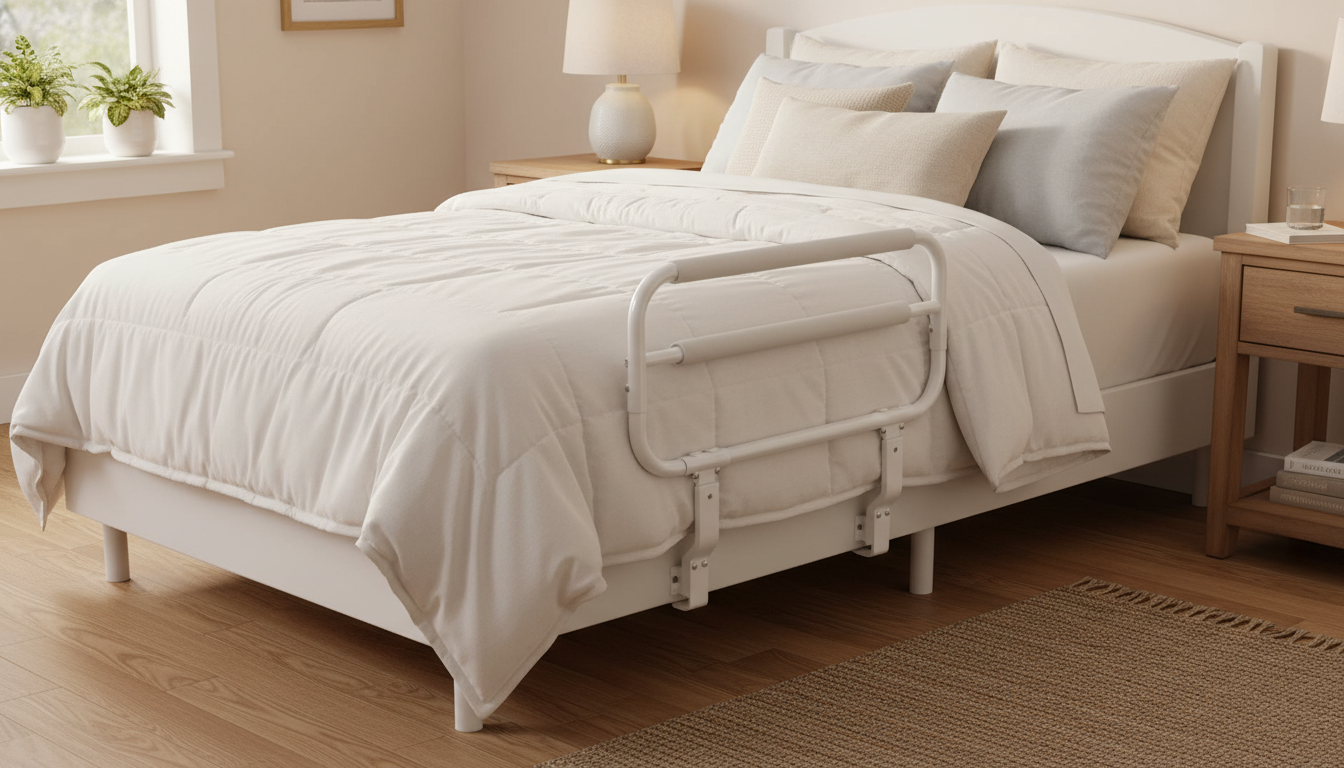
Why Bed Rails Matter for Senior Safety
Falls from bed are one of the most common and preventable injuries among older adults. The CDC reports that over 2.5 million seniors are treated in emergency departments for fall-related injuries each year, and a significant portion of those falls happen at the bedside — during the vulnerable moments of getting in and out of bed, or while shifting position during sleep.
Bed rails for seniors — also called bed safety rails, bed assist rails, or bedside safety rails — serve two primary functions. First, they act as a barrier to prevent rolling out of bed during sleep, which is especially critical for seniors with dementia, Alzheimer's disease, Parkinson's disease, or conditions that cause involuntary movement. Second, they provide a stable handhold for getting in and out of bed, reducing the strain on joints and muscles that leads to loss of balance.
For families managing fall prevention at home, bed rails are one of the most affordable and impactful interventions available. Most models cost between $30 and $150, install in minutes without tools, and can reduce bedside fall risk substantially when matched to the right user and bed type.
However, bed rails are not without risk. The FDA has documented entrapment hazards, and the CPSC has issued recalls on specific models. This guide covers everything you need to know to choose, install, and use bed rails safely.
Types of Bed Rails for Seniors
Bed rails come in several configurations, each designed for different needs, bed types, and mobility levels. Understanding the differences is critical to selecting the right model.
Full Length Bed Rails
Full length bed rails extend along the entire side of the mattress, from the head to the foot of the bed. They provide maximum roll-off protection and are the most common choice for seniors with dementia, Alzheimer's disease, or conditions that cause significant nighttime movement.
- Best For: Seniors who move frequently during sleep, those with cognitive impairment, or anyone at high risk of rolling out of bed.
- Considerations: Full length rails can make it more difficult to get in and out of bed independently. They also carry the highest entrapment risk if gaps exist between the rail, mattress, and bed frame.
- Cost: $50 to $150 per rail.
Half Length Bed Rails
Half length bed rails cover approximately the upper half of the mattress, protecting the head and torso area while leaving the lower portion of the bed open for easy entry and exit. This is the most popular configuration for seniors who need both fall prevention and independent mobility.
- Best For: Seniors who can get in and out of bed independently but need support during the transition. Also ideal for those who primarily roll toward the head of the bed.
- Considerations: The open lower section means less roll-off protection for seniors who move toward the foot of the bed during sleep.
- Cost: $30 to $100 per rail.
Fold Down Bed Rails
Fold down bed rails feature a hinge mechanism that allows the rail to be lowered flat when not needed and raised when the senior is in bed. This design eliminates the need to remove and reinstall the rail for bed-making or when the senior wants unobstructed access.
- Best For: Caregivers who need easy access to the bed for linen changes, medical care, or transfer assistance. Also preferred by seniors who want a rail at night but unobstructed daytime access.
- Considerations: The hinge mechanism adds a potential pinch point that must be checked during installation. Some fold-down models are less rigid than fixed rails.
- Cost: $60 to $180 per rail.
Swing Down Bed Rails
Similar to fold down rails but with a pivot mechanism that swings the rail down and under the mattress rather than folding flat. Swing down bed rails typically offer a more robust locking mechanism.
- Best For: Hospital-style beds or adjustable beds where a fold-flat design would interfere with bed articulation.
- Cost: $80 to $200 per rail.
Bed Assist Rails and Handles
Bed assist rails — sometimes called bed canes or bed handles — are compact support devices that slide between the mattress and box spring or bed frame. They provide a single sturdy handle for gripping during sit-to-stand transitions rather than a continuous barrier along the bed.
- Best For: Seniors who primarily need help getting up from a lying or sitting position but do not have significant roll-off risk. Excellent after hip replacement, back surgery, or for seniors with arthritis.
- Considerations: These do not prevent rolling out of bed. They are mobility aids, not barriers.
- Cost: $25 to $80.
Portable Bed Rails for Travel
Lightweight, collapsible bed rails designed for use in hotels, family members' homes, or any temporary sleeping arrangement. Most portable bed rails for travel fold flat and fit in a suitcase or travel bag.
- Best For: Seniors who travel and need consistent fall protection away from home.
- Cost: $25 to $70.
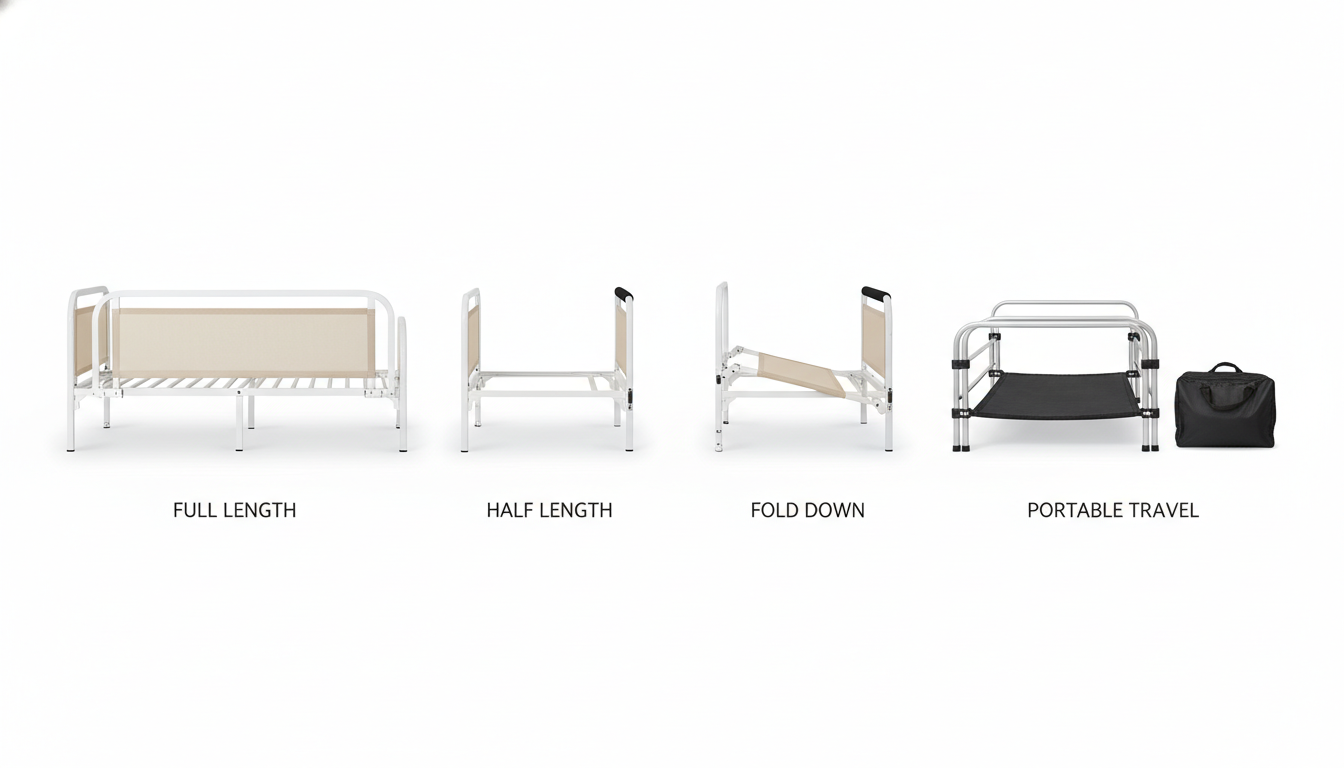 The right bed rail type depends on the senior's mobility level, sleep behavior, and whether independent bed entry/exit is needed
Bed Rail Comparison Chart
| Type | Roll-Off Protection | Sit-to-Stand Support | Easy Bed Entry/Exit | Cost Range |
|---|---|---|---|---|
| Full length | Excellent | Limited | Difficult | $50 – $150 |
| Half length | Good (upper body) | Good | Easy | $30 – $100 |
| Fold down | Good to Excellent | Moderate | Easy (when lowered) | $60 – $180 |
| Swing down | Excellent | Moderate | Easy (when lowered) | $80 – $200 |
| Bed assist rail/handle | None | Excellent | Easy | $25 – $80 |
| Portable/travel | Moderate | Limited | Easy | $25 – $70 |
Key Features to Look For
Not all bed rails are created equal. These features separate a safe, effective bed rail from one that may create more problems than it solves.
Weight Capacity
Every bed rail has a rated weight capacity that indicates how much downward and lateral force it can support. Standard adult bed rails typically support 200 to 300 pounds, while heavy-duty or bariatric models support 400 to 500 pounds. Always choose a rail rated for at least 1.5 times the user's body weight — a senior weighing 180 pounds should use a rail rated for at least 270 pounds.
Non-Slip Handle and Grip
The handle surface matters enormously. Look for bed rails with a non-slip handle — either a foam-padded grip, rubberized coating, or textured metal surface. A smooth chrome handle becomes slippery with lotion, sweat, or moisture and can cause the very fall it is supposed to prevent.
Adjustable Height and Width
Adjustable bed rails accommodate different mattress heights and bed frame widths. The rail should extend at least 15 to 20 inches above the top of the mattress to provide an effective barrier. Most quality bed rails offer height adjustment in 1-inch increments.
Storage Pocket
Many bed rails include a storage pocket or organizer pouch attached to the rail. This keeps essentials like a phone, remote control, water bottle, glasses, or medications within arm's reach — eliminating the need to lean or reach to a nightstand, which is itself a fall risk.
Motion Light
Some premium bed rails feature a built-in motion-activated LED light that illuminates the floor area when the senior swings their legs over the side of the bed. This addresses one of the most dangerous scenarios: a senior getting up in a dark room to use the bathroom at night.
Gap Protection
The space between the bed rail, mattress edge, and bed frame is where entrapment injuries occur. Look for rails with gap-reducing bumpers, foam inserts, or designs that sit flush against the mattress. The FDA recommends that gaps should be no wider than 4.75 inches — small enough that a head, neck, or limb cannot become trapped.
Safety Concerns, FDA Warnings, and Entrapment Risks
Bed rails save lives, but they can also cause serious injury or death if improperly matched, installed, or maintained. Families must understand these risks before making a purchase.
Entrapment Risk Zones
The FDA has identified seven entrapment zones around hospital and home bed rails where a patient's body — particularly the head, neck, or chest — can become trapped. The most dangerous zones for home bed rails are:
- Zone 1: Within the rail bars or openings (if the rail has a slatted design)
- Zone 2: Between the top of the compressed mattress and the bottom of the rail
- Zone 3: Between the rail and the mattress edge
- Zone 4: Between the rail end and the side edge of the head or foot board
Critical Safety Warning: The FDA has received over 900 reports of patients caught, trapped, entangled, or strangled in bed rails, with many resulting in death. Most incidents involve seniors with dementia or cognitive impairment who attempt to climb over or through the rail. Proper rail selection, gap elimination, and regular inspection are essential.
CPSC Recalls and Compliance
The Consumer Product Safety Commission (CPSC) has issued recalls on multiple bed rail models over the years. Before purchasing any bed rail, check the current recall database for the specific model. Key recall triggers include:
- Excessive gaps between the rail and mattress
- Weak locking mechanisms that allow the rail to collapse under pressure
- Sharp edges or pinch points on fold-down mechanisms
- Failure to support the rated weight capacity
Who Should Not Use Bed Rails
Bed rails are not appropriate for every senior. They should be avoided or used with extreme caution for:
- Seniors with severe dementia or Alzheimer's who may attempt to climb over the rail — the climb-over-and-fall scenario produces worse injuries than a bed-level fall
- Seniors who are highly agitated or restless in bed
- Users with beds that have gaps between the mattress and headboard/footboard that cannot be eliminated
- Seniors using undersized mattresses that leave gaps at the rail interface
For these populations, bed rail alternatives such as low-profile beds, floor mats, and bed alarm systems may be safer options.
Bed Rails for Specific Conditions
Different medical conditions require different bed rail configurations. Here is what the evidence supports for the most common conditions among seniors.
Bed Rails for Dementia and Alzheimer's
Seniors with dementia or Alzheimer's disease are at the highest risk for both bed falls and bed rail entrapment. The challenge is that cognitive impairment makes it impossible for the person to understand the rail's purpose or remember that it is there. Research suggests using padded, full-length rails with continuous surfaces (no bars or openings) combined with a bed alarm sensor that alerts the caregiver when the person attempts to exit the bed. See our memory care guide for comprehensive strategies.
Bed Rails for Parkinson's Disease
Parkinson's disease causes rigidity, tremor, and difficulty initiating movement — all of which make getting in and out of bed extremely challenging. A bed assist rail with a non-slip handle positioned at the upper-body level provides the leverage point needed for the sit-to-stand transition. The handle should be textured or padded, as Parkinson's tremor makes gripping smooth surfaces unreliable.
Bed Rails After Hip Replacement or Surgery
After hip replacement or back surgery, the primary need is sit-to-stand support rather than roll-off prevention. A bed assist handle or half-length rail on the surgery side provides the necessary leverage without requiring the senior to twist or rotate their body — movements that are restricted during recovery. Many orthopedic surgeons specifically recommend bed assist bars for the first 6 to 12 weeks of recovery.
Bed Rails for Arthritis
Arthritis affects grip strength and joint flexibility. For seniors with arthritis, choose bed rails with oversized, ergonomic handles that can be gripped with an open palm rather than requiring a full-hand grasp. Foam-padded handles with a diameter of 1.25 to 1.5 inches are optimal — the same grip specification used for bathroom grab bars.
Bed Rails for Balance and Mobility Issues
For seniors with general balance problems, multiple sclerosis, or mobility limitations from stroke recovery, a combination approach often works best: a half-length bed rail on one side for sit-to-stand support, paired with a bed alarm mat on the floor to alert caregivers if the senior gets up unassisted during the night.
Top Bed Rail Brands Comparison
These are the most widely recommended bed rail brands based on safety records, weight capacity, and user reviews.
| Brand / Model | Type | Weight Capacity | Key Feature | Price Range |
|---|---|---|---|---|
| Stander EZ Adjust | Half length, fold down | 300 lbs | 5-position height adjustment | $60 – $90 |
| Medline Bed Assist Bar | Bed assist handle | 250 lbs | Height-adjustable with storage pocket | $40 – $65 |
| Drive Medical Half Rail | Half length | 250 lbs | Chrome-plated steel, no-tool install | $35 – $60 |
| Lunderg Bed Rail | Half length with pocket | 300 lbs | Storage pocket + motion LED light | $45 – $75 |
| Carex Bed Support Rail | Bed assist handle | 250 lbs | Compact design, works with most beds | $30 – $50 |
| Vaunn Medical Bed Rail | Full length, fold down | 300 lbs | Mesh panel prevents entrapment | $55 – $90 |
Installation Guide for Bed Rails
Proper installation is the single most important factor in bed rail safety. An improperly installed rail creates entrapment gaps and may collapse under load.
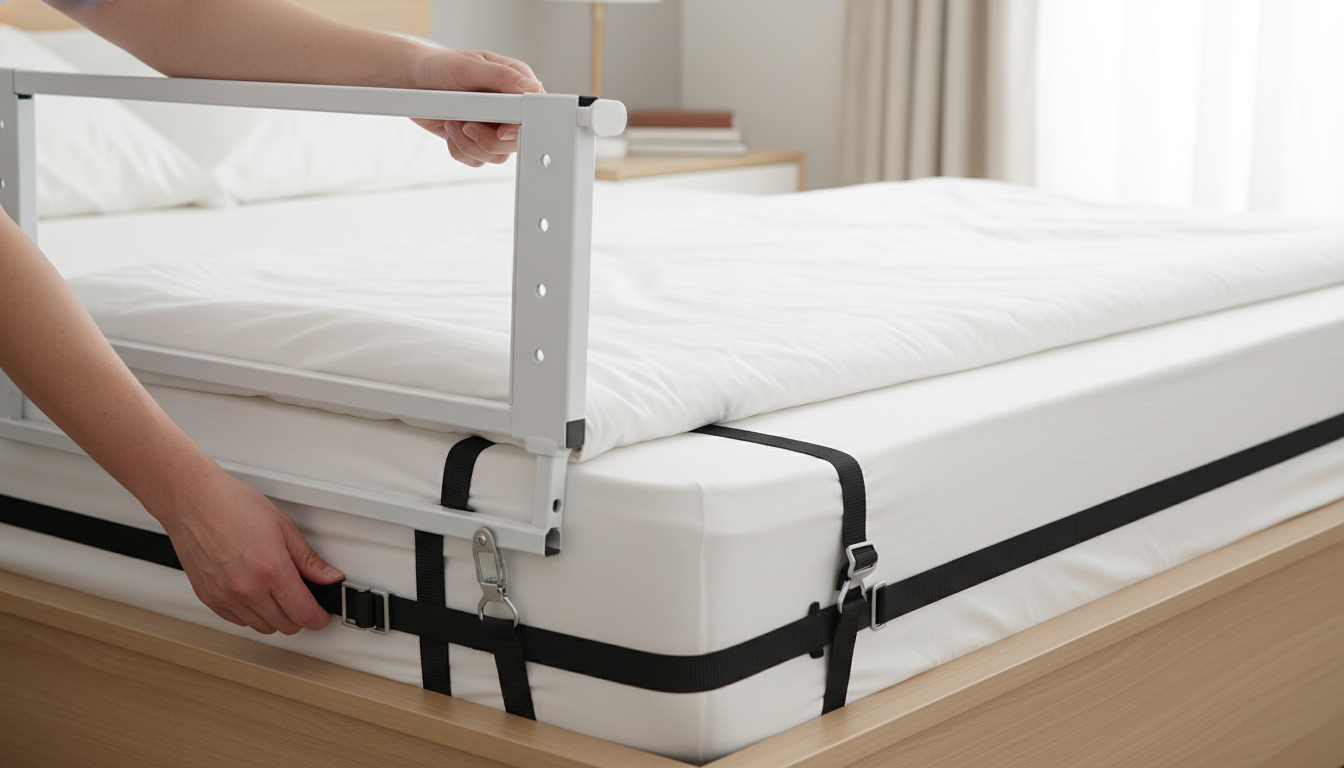 Bed rails that slide between the mattress and box spring must be secured so they cannot shift or create gaps during use
Step-by-Step Installation
- Check Compatibility: Verify that the bed rail is designed for your bed type — standard bed frame, platform bed, or adjustable bed. Most bed rails are not compatible with waterbeds, air mattresses, or futons.
- Position the Base Plate: Slide the base plate or anchor board between the mattress and the box spring (or bed frame for platform beds). The plate should sit flat and extend at least 12 inches under the mattress to prevent tipping.
- Secure the Mounting Straps: If the rail includes safety straps, route them around or under the bed frame and tighten. These straps prevent the rail from shifting when weight is applied.
- Adjust the Height: Set the rail height so that it extends 15 to 20 inches above the mattress surface. The top of the rail should be above the senior's hip level when they are lying down.
- Eliminate All Gaps: This is the critical safety step. Check for gaps between the rail and the mattress, between the mattress and headboard, and within the rail structure itself. Use pool noodles, rolled towels, or commercial gap-filling bumpers to eliminate any space wider than 4.75 inches.
- Load Test: Press firmly on the rail from multiple angles — downward, outward, and at a diagonal. The rail must not shift, tip, or collapse. Have the senior use the rail while you observe to confirm stability.
Bed Rails for Adjustable Beds
Adjustable beds present unique challenges because the mattress changes position. Standard bed rails that rely on mattress weight to stay in place can shift when the head or foot section is raised. Look for bed rails specifically designed for adjustable beds — these typically attach to the bed frame rather than relying on mattress compression. The Stander EZ Adjust and several hospital-grade models are compatible with adjustable bed frames.
Cost, Medicare Coverage & HSA/FSA Eligibility
Bed Rail Cost Overview
Bed rails for home use range from $25 to $200 depending on type, features, and brand. The majority of seniors find that a $40 to $100 half-length rail meets their needs. Here is the cost breakdown by category:
- Basic bed assist handle: $25 to $50
- Half-length bed rail: $30 to $100
- Full-length bed rail: $50 to $150
- Fold down / swing down rail: $60 to $200
- Portable travel rail: $25 to $70
- Hospital-grade bed rail set (pair): $150 to $400
Medicare Coverage for Bed Rails
Medicare Part B may cover bed rails when they are classified as Durable Medical Equipment (DME) and prescribed by a physician as medically necessary. Coverage is most likely when:
- The bed rail is part of a hospital bed system (Medicare covers hospital beds for home use under certain conditions)
- A physician documents the medical necessity — typically a diagnosis involving fall risk, dementia, or post-surgical recovery
- The supplier is Medicare-enrolled
Standalone bed rails purchased from retail stores are generally not covered by Medicare unless they are part of a prescribed hospital bed package. Check our guide on Medicare coverage for home modifications for details on the documentation process.
HSA and FSA Eligibility
Bed rails for seniors are generally HSA and FSA eligible when purchased for a medical purpose. Keep the receipt and a copy of any physician recommendation. Most health savings account administrators classify bed rails as a qualified medical expense without requiring a Letter of Medical Necessity, though having one strengthens your claim.
For additional funding options, see our comprehensive financial assistance guide for senior home modifications.
Bed Rail Alternatives
When bed rails are not appropriate — whether due to entrapment risk, cognitive impairment severity, or personal preference — several alternatives provide bed fall protection through different mechanisms.
| Alternative | How It Works | Best For | Cost |
|---|---|---|---|
| Low-profile bed frame | Reduces bed height to 8–12 inches from floor | Dementia patients, severe roll-off risk | $100 – $400 |
| Bed bumper / foam wedge | Soft foam barrier under the fitted sheet | Mild roll-off risk, entrapment concern | $20 – $60 |
| Floor mat / crash mat | Cushioned mat beside the bed to absorb impact | Inevitable falls, dementia patients | $30 – $80 |
| Bed alarm / sensor pad | Alerts caregiver when senior leaves the bed | Nighttime monitoring, non-wearable fall detection | $30 – $150 |
| Body positioning pillow | Wedge or bolster pillow prevents rolling | Mild positioning issues, comfort-focused | $15 – $50 |
For seniors with severe cognitive impairment, the combination of a low-profile bed + floor mat + bed alarm is often considered safer than bed rails because it eliminates entrapment risk entirely while still alerting caregivers to nighttime activity.
The Bottom Line
Bed rails for seniors safety is not a one-size-fits-all decision. The right bed rail depends on the senior's specific condition, mobility level, cognitive status, bed type, and whether the primary need is roll-off prevention or sit-to-stand support.
For most seniors with moderate mobility who need help getting in and out of bed, a half-length bed rail with a non-slip handle and storage pocket provides the best balance of safety, accessibility, and value. For seniors with dementia or Alzheimer's, the decision requires more careful evaluation — and may point toward alternatives rather than traditional rails.
Regardless of which option you choose, the installation and gap-elimination steps are non-negotiable. An improperly installed bed rail is more dangerous than no rail at all. Take the time to check every entrapment zone, load-test the rail, and inspect it monthly for shifting or wear.
Bed rail safety fits into a broader fall prevention strategy that should include grab bars in bathrooms, proper lighting, clear pathways, and a comprehensive home safety assessment. Start with the bedside — where your loved one is most vulnerable — and build outward from there.
Ready to Take Action?
Explore our comprehensive fall prevention resources to keep your loved one safe in every room of the home — starting with the bedroom.
Explore Fall Prevention About Margaret Chen
Certified Aging-in-Place Specialist & Senior Care Advisor
CAPS-certified senior care advisor with 15+ years helping families plan for safe aging at home.
Related Articles

Fall Prevention for Seniors: The Complete Home Safety Guide
Evidence-based fall prevention strategies for seniors covering home modifications, exercise, medication management, and environmental hazard reduction.
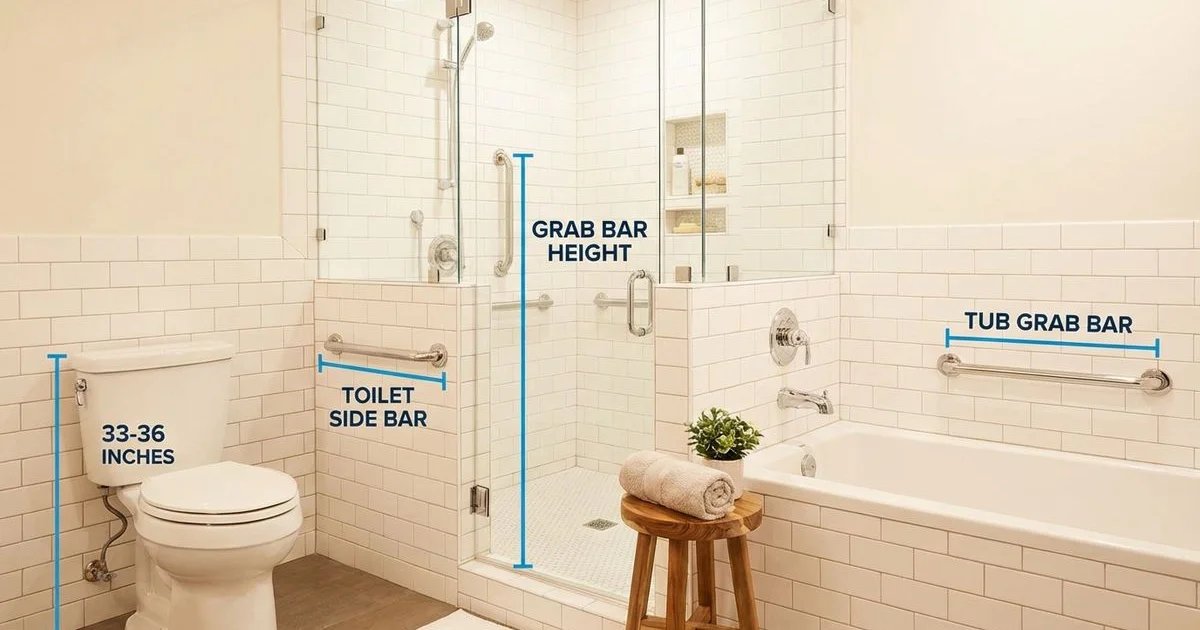
Where and How to Install Grab Bars: Location Guide With Diagrams
Expert guide to grab bar placement in bathrooms, hallways, and bedrooms. Includes installation heights, recommended products, and DIY vs. professional advice.

Memory Care: What Families Need to Know
Comprehensive guide to memory care options for families navigating dementia and Alzheimer's care decisions at home and in facilities.